Key Highlights
- Python is a programming language, and many implementations that run Python code include CPython, PyPy, and Jython.
- Since CPython is the official and most popular implementation, most developers choose it by default.
- Different Python implementations are built to solve different problems, such as improving performance, integrating with Java, or running on resource-constrained devices.
- Understanding Python implementations helps you choose the right runtime for your projects and clears up common misconceptions about how Python works.
- By the end of this guide, you'll know the differences between CPython, PyPy, Jython, and other popular implementations, along with their ideal use cases.
Ever Wondered Why Python Has So Many "Versions"?
Imagine you're watching a Python tutorial, and the instructor suddenly says:
"CPython is the official implementation of Python."
A few minutes later, someone in the comments mentions PyPy. Then you come across Jython, MicroPython, or even IronPython.
It's easy to wonder at this point:
"I installed Python. So why am I hearing about all these different names?"
One simple concept that many beginners ignore holds the key to the solution:
Python is the language. Programs that comprehend and use that language include CPython, PyPy, and Jython.
Think of it like music. A song remains the same whether you play it on a guitar, piano, or violin. The instrument changes, but the composition doesn't. Similarly, the Python language stays the same. What changes is how different implementations execute your Python code.
Once you understand this distinction, terms like CPython, PyPy, and Jython become much easier to understand.
Python vs CPython: What's the Difference?
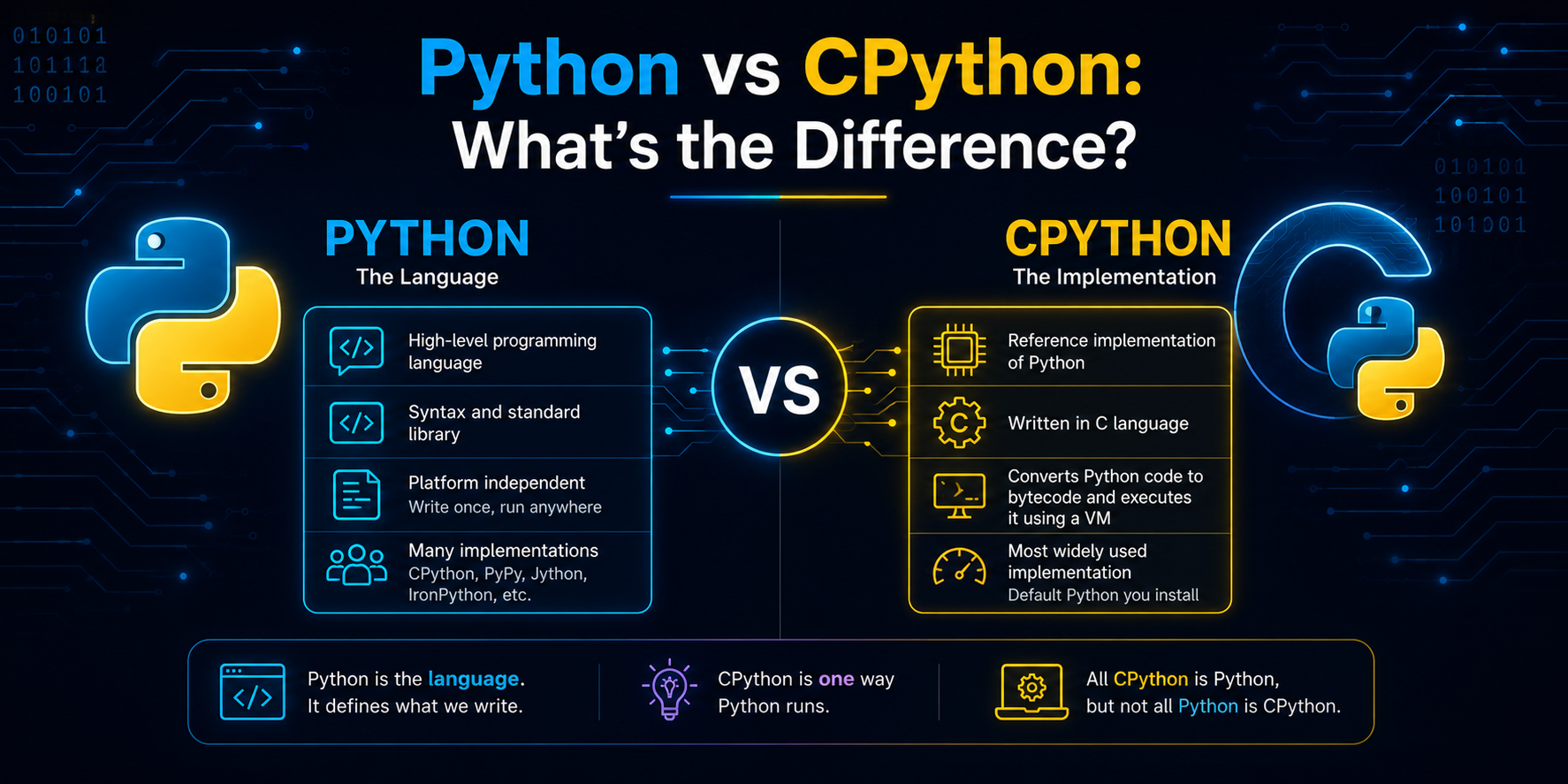
Many developers use Python and CPython interchangeably, but they don't mean the same thing.
Here's the simplest way to understand the difference.
Python is the programming language. It defines the rules for writing Python programs, such as syntax, keywords, operators, data types, and expected behavior.
For example, Python defines that the following code should print Hello on the screen:
print("Hello")However, Python doesn't define how your computer should execute this code. It only defines what the code means.
That's where CPython comes in.
CPython is software built to follow Python's rules and execute Python programs. In other words, it is an implementation of the Python language.
A simple analogy makes this easier to understand.
Consider the language of English. Even if people from different nations speak English in different voices, with distinct accents, and at varying speeds, they are still speaking the same language.
In the same way, different programs that adhere to the same language definition can comprehend and run Python.
            Python Language
      ┌───────────┼───────────┐
      │           │           │
   CPython      PyPy       Jython
Each implementation follows Python's language rules but uses a different approach behind the scenes.
What Is Python?
Python is often known as a programming language, but a more accurate way to think about it is as a language specification.
A language specification defines the rules that every Python implementation must follow. These rules include:
- The syntax used to write Python programs
- Keywords such as if, for, and while
- Data types like integers, strings, and lists
- The expected behavior of Python code
For example, consider this program:
age = 20

if age >= 18:
    print("Eligible to vote")
No matter which Python implementation you use, the output should remain the same because they all follow the same language specification.
What differs is how that code is processed and executed internally.
That's the responsibility of a Python implementation.
What Is a Python Implementation?
A Python implementation is software that reads your Python code and performs all the work needed to run it.
Instead of simply reading a .py file and displaying the output, an implementation carries out several important tasks behind the scenes.
These responsibilities include:
- Reading and understanding your source code.
- Checking whether the code follows Python's syntax rules.
- Converting the code into a form that can be executed.
- Managing memory while the program runs.
- Creating and deleting Python objects.
- Executing the instructions and producing the final output.
In short, a Python implementation is the engine that brings your Python code to life.
Without it, your computer would only see a text file filled with characters, it wouldn't know how to execute your program.
Why Are There Multiple Python Implementations?
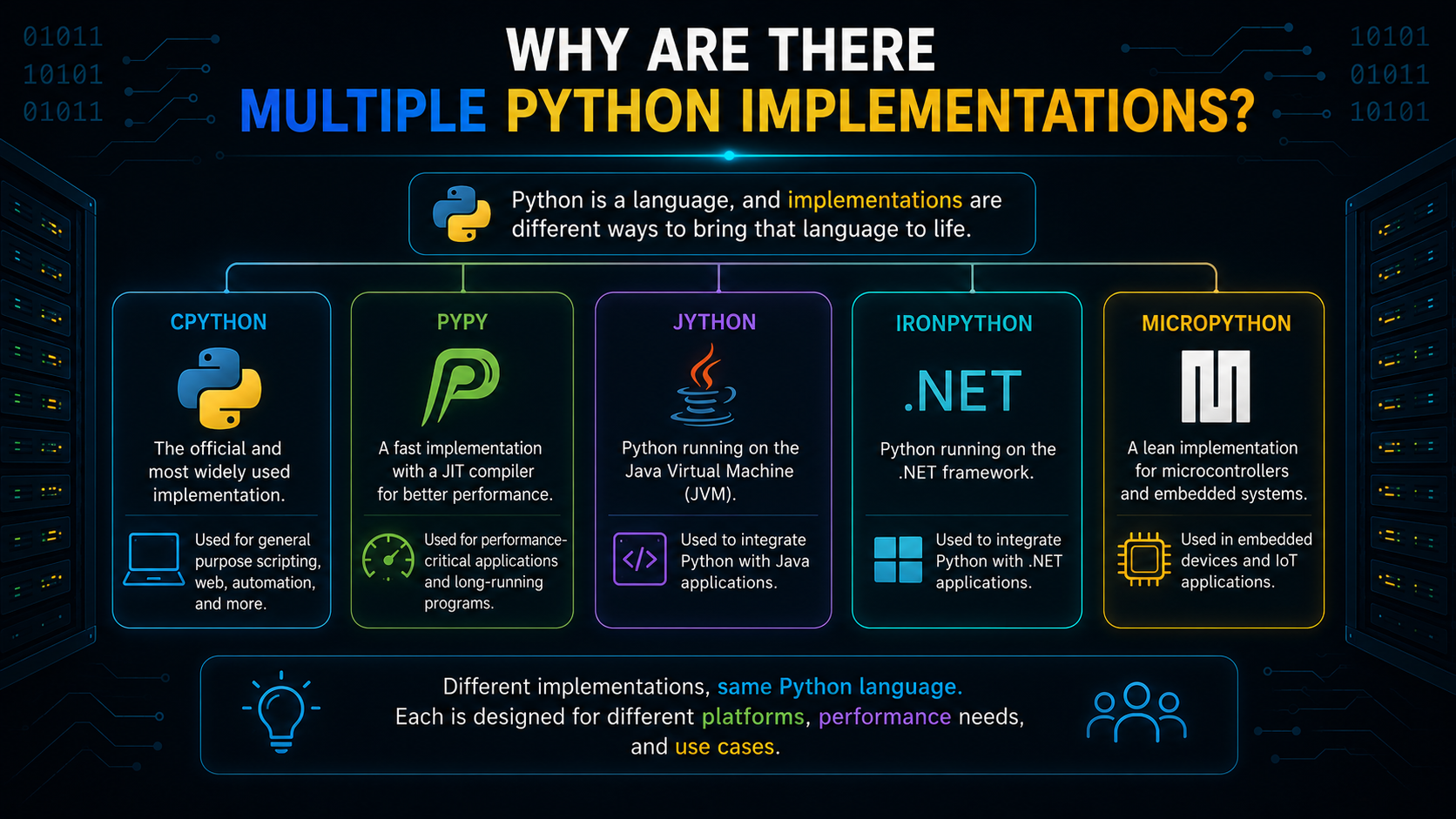
If CPython already runs Python programs, why create PyPy, Jython, or other implementations?
The answer is simple:
Different developers have different priorities.
Some applications need maximum compatibility with Python libraries.
Others need better execution speed.
Some must integrate with Java applications, while others are designed to run on tiny microcontrollers with very limited memory.
The Python ecosystem provides several implementations, each concentrating on a certain objective, rather than creating a single implementation that attempts to optimize everything.
For example:
- Compatibility, stability, and extensive library support are given top priority in CPython.
- PyPy focuses on improving performance using Just-in-Time (JIT) compilation.
- Jython enables Python programs to run on the Java Virtual Machine (JVM).
- MicroPython is built for embedded systems and IoT devices with limited resources.
Although these implementations differ internally, they all aim to support the same Python language.
That's why the same Python program can often run on multiple implementations with little or no modification.
What Is CPython?
If you've installed Python from the official Python website, you're almost certainly using CPython. It is the reference implementation of Python, maintained by the Python Software Foundation (PSF). Thanks to its stability, broad library support, and active community, CPython powers most Python applications and popular frameworks like Django, Flask, NumPy, and Pandas.
Why Is It Called CPython?
The name CPython comes from the programming language it's built with, C. While you write code in Python, the interpreter that executes your code is implemented primarily in C.
C + Python
     │
     ▼
 CPython
Why Was CPython Written in C?
Because of its excellent performance, effective memory management, direct operating system access, and cross-platform portability, C was selected. Even while CPython's internal implementation is far more complicated than the Python code developers write, these benefits make it quick, dependable, and able to serve the vast Python ecosystem.
What Does CPython Do Behind the Scenes?
CPython carries out a number of operations in the background to transform your code into a functional application when you run a Python program.
1. Parsing Your Code
CPython reads your source code, checks whether it follows Python's syntax rules, and converts it into an internal structure. If it finds invalid syntax, it stops execution and raises a SyntaxError.
2. Compiling to Bytecode
CPython immediately converts the code into Python bytecode, an intermediate format that the Python Virtual Machine (PVM) can effectively run if the code is acceptable.
3. Managing Memory
Whenever you create variables, lists, or other objects, CPython automatically allocates and manages memory, so you don't have to handle it manually.
4. Clearing Out Used Items
CPython makes it possible for applications to run efficiently without the need for human memory management by combining garbage collection and reference counting to free unused memory.
5. Managing Python Objects
Everything in Python is an object, including strings, integers, functions, and classes. These objects are created, stored, and managed by CPython during the execution of your program.
6. Putting Your Program into Action
In the end, CPython executes the created bytecode using the Python Virtual Machine (PVM), allowing your program to do tasks like file management, calculations, and output display.
Other Popular Python Implementations
CPython is the most popular, there are other Python implementations. Different implementations are designed to meet different needs, such as improving performance, integrating with other platforms, or running on devices with limited resources.
Let's look at the most popular alternatives.
PyPy
If performance is your top priority, PyPy is worth considering.
PyPy is a Python implementation that focuses on speed. Unlike CPython, it includes a Just-in-Time (JIT) compiler, which identifies code that's executed repeatedly and converts it into optimized machine code while the program is running.
Python Code
       │
       ▼
   Bytecode
       │
       ▼
 JIT Compiler
       │
       ▼
 Machine Code
Because of this optimization, PyPy can execute many CPU-intensive and long-running programs faster than CPython.
Advantages
- Faster execution for many long-running applications.
- Enhances performance without necessitating significant code modifications.
- Supports most standard Python programs.
Limitations
- Compared to CPython, it uses more RAM.
- There may be compatibility problems with some libraries that depend on C extensions unique to CPython.
Best for: Scientific computing, simulations, data processing, and performance-focused applications.
Jython
Jython is designed for developers who want to combine Python with Java.
Instead of running on the Python Virtual Machine, Jython executes Python code on the Java Virtual Machine (JVM). This allows Python programs to access Java classes and libraries directly.
Python Code
       │
       ▼
 Java Bytecode
       │
       ▼
      JVM
Advantages
- Seamlessly integrates with Java applications.
- Can use existing Java libraries.
- Suitable for JVM-based enterprise environments.
Limitations
- Supports older Python versions compared to CPython.
- Doesn't support many CPython-specific C extension libraries.
Best for: Java-based enterprise applications.
IronPython
IronPython is built for the .NET ecosystem.
Instead of the JVM, it runs on Microsoft's Common Language Runtime (CLR), making it easier to integrate Python with languages like C# and other .NET applications.
Python Code
       │
       ▼
      CLR
Best for
- Developing .NET applications.
- Working with C# projects.
- Integrating Python into Microsoft's development ecosystem.
MicroPython
Not every computer has gigabytes of memory. Devices such as ESP32, Raspberry Pi Pico, and other microcontrollers have very limited resources.
That's where MicroPython comes in.
A lightweight implementation called MicroPython was created especially for Internet of Things (IoT) devices and embedded systems.
Its primary goals are:
- Small memory footprint.
- Low power consumption.
- Efficient execution on resource-constrained hardware.
Because it's optimized for tiny devices, it doesn't include every feature available in CPython.
Best for: Robotics, IoT projects, sensors, and embedded systems.
Stackless Python
Stackless Python is built to manage high levels of concurrency.
Applications can effectively handle thousands of concurrent tasks because to its introduction of lightweight task scheduling.
Instead of generating several operating system threads, Stackless Python schedules simple operations with little overhead.
Best for: Multiplayer games, simulations, and applications that require high concurrency.
GraalPython
GraalPython is part of GraalVM, a platform that supports multiple programming languages.
Its goal is to improve interoperability, allowing Python applications to work alongside languages such as Java, JavaScript, and others within the same runtime.
It's primarily used in specialized enterprise environments where multiple languages need to interact efficiently.
CPython vs Other Python Implementations
Each implementation is designed with a different goal in mind.
| Implementation | Primary Goal | Best For |
|---|---|---|
| CPython | General-purpose Python | Learning, web development, AI, automation |
| PyPy | Performance | Long-running and CPU-intensive programs |
| Jython | Java integration | JVM-based applications |
| IronPython | .NET integration | C# and .NET projects |
| MicroPython | Embedded systems | IoT devices and microcontrollers |
| Stackless Python | Concurrency | Games and simulations |
| GraalPython | Polyglot runtime | Multi-language enterprise applications |
As you can see, these implementations aren't competing to replace CPython. Instead, each one is built to solve a specific problem while supporting the Python language.
Why Does CPython Dominate?
With so many Python implementations available, you might wonder why CPython remains the most widely used.
The answer lies in its balance of stability, compatibility, and community support.
CPython is the reference implementation, so new Python features are introduced here first. It also has excellent documentation, a mature ecosystem, and broad support from developers worldwide. Most third-party libraries, frameworks, and tools are developed and tested with CPython before they support other implementations.
For instance, CPython is the ideal option for data science, machine learning, web development, and automation because well-known libraries like NumPy, Pandas, SciPy, and PyTorch mainly rely on it.
CPython is typically the best choice unless your project has a unique requirement, like improved performance or Java integration.
Python Language vs Python Implementation
One of the most important concepts to understand is the difference between a programming language and its implementation.
The Python language defines what your code should do. It specifies the syntax, keywords, operators, and expected behavior.
The execution of that code is determined by a Python implementation.
Take this statement, for instance:
print("Hello")"Hello" should be shown, according to the Python language.
The implementation decides how to handle memory, carry out instructions, process the code, and generate the output.
Simply put:
Python Language
        │
Defines what the code means
        │
        ▼
Python Implementation
        │
Decides how the code runs
        │
        ▼
Program Output
The same Python language can be supported by several implementations employing various internal technologies because of this division.
Common Misconceptions About Python Implementations
Let's clear up a few common misunderstandings.
Misconception 1: Python and CPython are the same.
In Reality: CPython is the official implementation of Python, the computer language.
Misconception 2: Python is only interpreted.
Reality: Different Python implementations execute code in different ways. For example, CPython first converts your code into bytecode before running it, while PyPy uses a Just-in-Time (JIT) compiler to optimize code that's executed repeatedly.
Misconception 3: Every Python implementation works the same internally.
Reality: They all follow the same language rules, but their internal architecture, execution model, and optimizations differ.
Misconception 4: Python is written in Python.
Reality: CPython, the implementation used by most Python developers, is built primarily using the C programming language.
Which Python Implementation Should You Choose?
For most developers, the answer is simple.
Choose CPython if you are:
- Learning Python.
- Building APIs or webpages.
- Utilising machine learning or data science.
- Creating scripts for automation.
- Seeking the highest level of library compatibility.
IronPython for the .NET environment, MicroPython for embedded devices or Internet of Things projects, PyPy if execution speed is your top priority, and Jython if you're interacting with Java applications.
The ideal choice will depend on the requirements of your project as each implementation has benefits over the others.
Conclusion
Python is a programming language, but the software that runs it can vary depending on your needs. CPython is the official and most widely used implementation, making it the best choice for beginners and most development projects. Other implementations, such as PyPy, Jython, IronPython, and MicroPython, are designed for specific use cases like performance, Java integration, .NET development, or embedded systems. Understanding these implementations gives you a better understanding of how Python works and helps you choose the right runtime for your projects.
Frequently Asked Questions
1. Are Python and CPython the same?
No, while Python is the programming language, CPython is the official implementation that executes Python programs.
2. Which Python implementation is best for novices?
CPython is the recommended choice since it is dependable, well-documented, and supported by most tutorials and libraries.
3. Why do several Python implementations exist?
Different implementations are designed to achieve different objectives, such enhancing performance, integrating with Java or .NET, or operating on low-memory devices.
4. Is PyPy faster than CPython?
Because PyPy utilizes a Just-in-Time (JIT) compiler, it can perform better than CPython for many CPU-intensive, long-running programs. However, the application determines performance.
5. What is MicroPython used for?
MicroPython is intended for embedded systems and Internet of Things devices with constrained memory and computing capability, such as the ESP32 and Raspberry Pi Pico.