Everything Is an Object in Python: What That Really Means
Key Highlights
- Almost everything in Python is an object, including characters, numbers, lists, functions, classes, and even modules. This consistent design makes the language easier to learn and use.
- An object isn't just data. It combines data with the operations (methods) that can be performed on that data.
- Every value you create in Python is automatically represented as an object, even before it's assigned to a variable.
- Since everything is an object, Python supports powerful features like object-oriented programming (OOP), first-class functions, and dynamic behavior.
- Understanding what an object is in Python helps explain how Python handles data, functions, classes, and built-in types throughout your programs.
Introduction
Imagine writing these three lines of code:
age = 25
message = "Hello, Python!"
print(message)
At first glance, they look completely different. One creates a number, another creates a string, and the third calls a function. Yet Python treats all three in a remarkably consistent way, they are all objects.
One of the fundamental design tenets of Python is this concept. Python depicts everything as an object with its own data and behavior, whether you're working with an integer, a list, a function, a class, or even a module.
Understanding this concept changes the way you think about Python. It explains why Python's object-oriented programming appears so natural, why variables may have classes assigned to them, and why functions can be supplied as arguments.
In this guide, you'll learn what an object is in Python, why almost everything is an object, and how this design makes Python flexible, consistent, and easy to extend.
What Does "Everything Is an Object" Actually Mean?
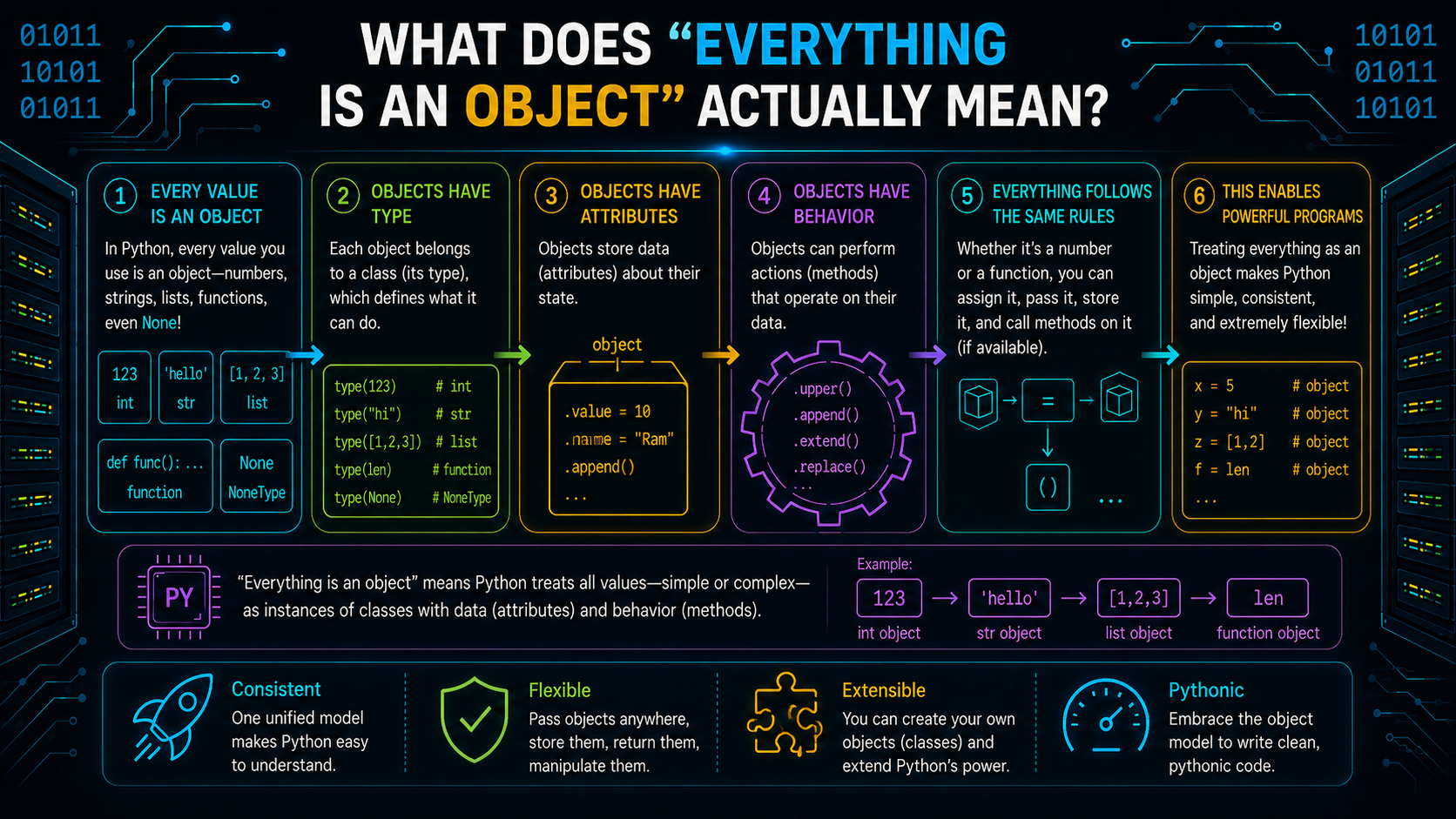
Every value you create or use in a program is represented as an object, according to Python's statement that "everything is an object." Python uses a single object model to manage integers, texts, functions, and classes rather than treating them as distinct things.
For example, all of the following are objects:
42
3.14
"Python"
True
[1, 2, 3]
{"name": "Alex"}
print
len
Although these objects represent different kinds of data, they all share one important characteristic: they belong to a specific type and support operations defined for that type.
For instance:
- Methods like replace() and upper() are available on a string object.
- A list object provides methods like append() and sort().
- A dictionary object provides methods like keys() and values().
This consistent design means you interact with every object in a similar way, regardless of what it represents.
Key Takeaway: An object in Python is more than just a value, it is an entity that combines data with the operations that can be performed on that data.
What Is Object in Python with example?
An object is the basic building block of every Python program. Whenever you create a value, Python creates an object to represent that value.
For example:
language = "Python"
marks = 95
is_passed = True
Here:
- "Python" is a string object.
- 95 is an integer object.
- True is a Boolean object.
Because built-in functions like print() and len() are objects, they may be passed to other functions or set to variables.
display = print

display("Hello")
Functions are objects, just like strings or integers, as this example shows.
Did You Know? In Python, classes, functions, modules, exceptions, and built-in data types are all objects. This unified design is one of the reasons Python is known for its simplicity and consistency.
Every Value You Create Is Already an Object
It's a frequent false assumption that a value doesn't become an object until it's placed in a variable. Even if you never give the value a name, Python really generates an object as soon as it exists.
For example, consider the expression:
100Even though it isn't assigned to a variable, Python still creates an integer object representing the value 100.
The same is true for other values:
"Hello"

False

(1, 2, 3)

{"Python", "Java"}
Each of these expressions creates an object of a different type.
When you later write:
score = 100Python doesn't turn 100 into an object at this point. The integer object already exists, and Python simply binds the name score to that object.
This distinction is important because objects exist independently of variables. Variables (or names) simply provide a way to access those objects in your code.
Objects Exist Before Variables
To understand this better, compare these two examples.
Example 1
"Python"Python creates a string object, even though no variable refers to it.
Example 2
language = "Python"Python creates (or reuses) the same type of string object and binds the name language to it.
The important difference is that the object exists in both cases. Assignment only creates a reference that lets you access it later.
This idea is one of the foundations of Python's object system and explains why objects, not variables, are at the center of the language's design.
Objects Are More Than Just Data
If objects only stored data, Python wouldn't be able to perform operations like converting text to uppercase, sorting a list, or adding an item to a dictionary. An object in Python combines data with the behavior that operates on that data.
In this case, in addition to storing text, a string object has functions like replace(), lower(), and upper(). In a same vein, a list object has functions like append(), remove(), and sort() in addition to storing a collection of items.
text = "python"
print(text.upper())

numbers = [3, 1, 2]
numbers.sort()
Each object exposes a different set of methods because every object belongs to a specific type. This is why you can call append() on a list but not on a string, or upper() on a string but not on an integer.
Objects Know How to Behave
Different objects support different operations based on their type.
| Object | Supported Operations |
|---|---|
| String | upper(), lower(), split() |
| List | append(), extend(), sort() |
| Dictionary | keys(), values(), items() |
This consistent design allows Python to treat everything as objects while still giving each object behavior that matches its purpose.
Why Functions Are Objects in Python
One of Python's most powerful features is that functions are objects. Unlike many programming languages where functions are treated differently from data, Python lets you store, pass, and return functions just like any other object.
This is why Python refers to functions as first-class objects.
Functions Can Be Assigned to Variables
Since a function is an object, you can assign it to another variable without calling it.
def greet():
    return "Hello!"

say_hello = greet

print(say_hello())
Here, say_hello and greet both refer to the same function object.
Functions Can Be Passed and Returned
Functions can be supplied as parameters to other functions and returned as values because they are objects.
def greet():
    return "Hello!"

def display(func):
    print(func())

display(greet)
This ability makes features such as callbacks, decorators, and higher-order functions possible.
Classes Are Objects Too
When learning what is class and object in Python, it's common to think that only objects created from a class are objects. In reality, the class itself is also an object.
Python creates a class object when it executes a class definition.
class Student:
    pass
Here, Student is a class object.
When you create an instance:
student1 = Student()Python creates a new instance object of the Student class.
Student (Class Object)
           │
          ▼
     Student()
           │
          ▼
 student1 (Instance Object)
This explains what is used to create an object in Python, a class acts as a blueprint, and calling the class creates an instance object.
Class Object vs Instance Object
An instance is a single object made from a class, whereas a class specifies the behavior and structure of objects.
Example:
class Car:
    def __init__(self, brand):
        self.brand = brand

car1 = Car("Toyota")
car2 = Car("Honda")
Here:
- Car is the class object.
- car1 and car2 are instance objects.
Both objects share the same blueprint but store different data.
This example clearly demonstrates what is class and object in Python with example.
Key Takeaway: A class is an object that acts as a blueprint, while every object created from it is called an instance object. Since classes are also objects, they can be assigned to variables, passed to functions, and used like other Python objects.
Python Treats Built-in Types as Objects
One of the best examples of Python's "everything is an object" philosophy is its built-in data types. Whether you're working with an integer, string, list, dictionary, or Boolean value, Python treats each one as an object with its own data and behavior.
For example:
age = 25
language = "Python"
topics = ["Objects", "Classes"]
student = {"name": "Alex"}
Here:
- 25 is an integer object (int)
- "Python" is a string object (str)
- ["Objects", "Classes"] is a list object (list)
- {"name": "Alex"} is a dictionary object (dict)
Although these objects represent different types of data, they all support methods and operations defined for their respective types.
For example:
language.upper()
topics.append("Functions")
student.keys()
Each object responds differently because every built-in type is implemented as a class in Python.
Key Takeaway: Built-in data types aren't special cases. They are objects created from built-in classes, which is why they provide their own methods and behavior.
Every Built-in Type Is a Class
Python's built-in types are actually classes, and every value you create is an instance of one of these classes.
You can verify this using the type() function.
print(type(25))
print(type("Python"))
print(type([1, 2, 3]))
Output
<class 'int'>
<class 'str'>
<class 'list'>
This shows that an integer is an instance of the int class, a string is an instance of the str class, and a list is an instance of the list class.
This directly answers the question "what is data type object in Python?" A data type such as int or str is a class, and every value created from it is an object.
Special Objects You'll Frequently Encounter
As you build more Python programs, you'll encounter a variety of built-in objects that are standard Python objects but don't resemble strings or numbers. Working with files, loops, and functional programming tools is much easier when you understand them.
File Object
Python always returns a file object when you use the open() function to open a file. The file's read, write, and close methods are provided by this object.
file = open("notes.txt", "r")

print(type(file))
Some commonly used methods include:
- read()
- readline()
- write()
- close()
Once you're done working with the file, it's recommended to close it or use a with statement to manage it automatically.
Enumerate Object
The enumerate() function returns an enumerate object, which generates an index and its corresponding value while iterating over a sequence.
languages = ["Python", "Java", "C++"]

for index, language in enumerate(languages):
    print(index, language)
Output:
0 Python
1 Java
2 C++
Instead of creating a separate counter, the enumerate object generates index-value pairs during iteration.
Map Object
A map object that applies a function to each item in an iterable and generates the results one at a time is returned by the map() function.
numbers = [1, 2, 3]

squares = map(lambda x: x * x, numbers)

print(list(squares))
Output
[1, 4, 9]Since a map object produces values only when needed, it is an example of a lazy iterator.
Iterable Object
Any object that can return its elements one at a time during iteration is considered iterable.
Common iterable objects include:
- Lists
- Tuples
- Strings
- Dictionaries
- Sets
- Range objects
Example:
for letter in "Python":
    print(letter)
Python automatically retrieves one character at a time because a string is an iterable object.
NoneType Object
None represents the absence of a value in Python. It isn't a keyword for "nothing"; it is an object whose type is NoneType.
value = None
print(type(value))
Output
<class 'NoneType'>Functions that don't explicitly return a value automatically return the None object.
Everything Is an Object Enables Object-Oriented Programming
The foundation of Python's object-oriented programming paradigm is the notion that everything is an object. Python can depict real-world entities as interacting objects as objects integrate data and behavior.
What Is Object Oriented Programming in Python?
Object-oriented programming (OOP) is a programming approach where applications are designed using classes and objects.
- A class defines the structure and behavior.
- An object is an instance created from that class.
For example:
class Student:
    def __init__(self, name):
        self.name = name
student1 = Student("Alex")
Here:
- Student is the class.
- student1 is an object created from that class.
This demonstrates what is class and object in Python and how objects are created from class definitions.
Why "Everything Is an Object" Matters in OOP
Since Python treats classes, functions, and built-in types as objects, they can all be stored in variables, passed to functions, or returned from functions. This consistent object model simplifies the language and supports core OOP concepts such as:
- Encapsulation – combining data and methods within an object.
- Inheritance – is the process of building new classes from preexisting ones.
- Polymorphism – permitting objects of distinct classes to react differently to the same method call.
Whether working with a built-in type like list or dict or a user-defined class, developers can apply the same concepts because all components adhere to the same object-based design.
Key Takeaway: Python sees almost every value, method, and class as an object, making its object-oriented programming style natural. Python is more adaptable, reusable, and simple to expand because to its consistent design.
Misunderstandings About Objects in Python
The idea that "everything is an object" frequently results in a few prevalent misunderstandings. You can better accurately comprehend Python's behavior and steer clear of frequent programming mistakes by being aware of these.
Does "Everything Is an Object" Mean Everything Behaves the Same?
No. Although everything in Python is an object, different objects provide different behaviors based on their type.
For example, both strings and lists are objects, but they support different methods.
text = "Python"
numbers = [3, 1, 2]

text.upper()      # Valid
numbers.sort()    # Valid

text.append("!")  # Error
An object only supports the operations defined for its type.
What Does 'int' Object Is Not Subscriptable Mean in Python?
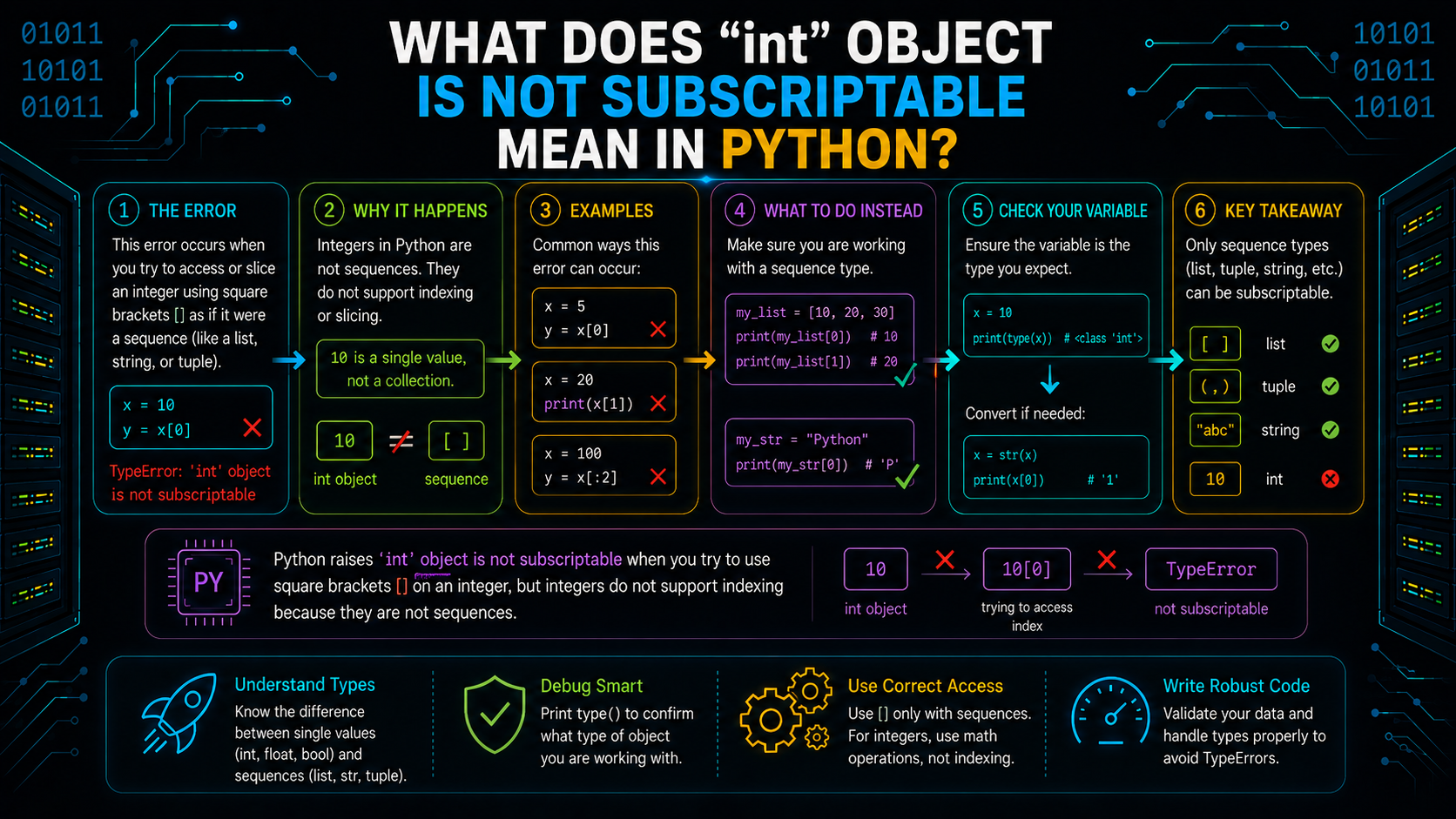
One of the most common beginner errors is:
age = 25
print(age[0])
Output
TypeError: 'int' object is not subscriptableThis error occurs because an integer object doesn't support indexing. Only sequence types such as strings, lists, and tuples can be accessed using square brackets ([]).
For example:
name = "Python"
print(name[0])
Output
PSince strings are sequence objects, indexing is allowed. Integers represent a single numeric value, so they cannot be indexed.
Note: The error 'int' object is not subscriptable doesn't mean there's a problem with the integer. It means you're trying to use an operation that the int object doesn't support.
Does Every Object Support Every Method?
No. Methods belong to specific object types.
For example:
- append() belongs to list objects.
- upper() belongs to string objects.
- keys() belongs to dictionary objects.
Trying to call a method that isn't defined for an object's type results in an AttributeError.
This is why understanding an object's type is important before using its methods.
Conclusion
Everything is an object rather than a language feature, it's a core design principle of Python. Numbers, strings, functions, classes, and built-in types all follow the same object model, making the language consistent and easier to work with. Once you understand what an object is in Python and how different objects define their own behavior, concepts like object-oriented programming, built-in data types, and function handling become much more intuitive. This foundation will also make it easier to learn advanced Python concepts as you continue your programming journey.
Frequently Asked Questions
1. What is an object in Python programming?▾
An object is the fundamental building block of Python. It represents a value along with the operations that can be performed on that value. Numbers, strings, lists, functions, classes, and modules are all objects.
2. What is class and object in Python?▾
A class is a blueprint for creating objects, while an object is an instance created from that class. For example, if Car is a class, my_car = Car() creates an object (instance) of that class.
3. What is an immutable object in Python?▾
An immutable object cannot be modified after it is created. Instead of changing the existing object, Python creates a new one when its value changes. Common immutable objects include integers, strings, tuples, and booleans.
4. What is mutable object in Python?▾
After it is created, a mutable object can be changed without having to create a new one. Lists, dictionaries, and sets are common examples of mutable objects.
5. What is an iterable object in Python?▾
An iterable object is any object whose elements can be accessed one at a time during iteration. Lists, tuples, strings, sets, dictionaries, and range objects are common iterable objects.
6. What is hashable object in Python?▾
A hashable object has a hash value that remains unchanged during its lifetime. Immutable objects like strings, integers, and tuples (containing only hashable elements) are hashable and can be used as dictionary keys or set elements.
7. What is object serialization in Python?▾
Object serialization is the process of converting a Python object into a format that can be stored or transmitted and later reconstructed. Python commonly uses the pickle module for serializing Python objects, while JSON is often used for exchanging structured data between applications.