Functional Programming in Python: map(), filter(), lambda, and Beyond
Key Takeaways
- Understand what functional programming is and how the functional programming paradigm differs from other programming styles.
- Learn why functions are first-class objects in Python and how they can be passed, returned, and stored like any other object.
- Explore the concept of higher-order functions and how they form the foundation of functional programming.
- Understand why Python supports functional programming even though it is a multi-paradigm language.
- Build the conceptual foundation needed to understand lambda, map(), filter(), reduce(), and function composition.
Introduction
"In functional programming, functions don't just perform work; they become the data you work with."
Most programmers think of functions as blocks of reusable code that execute a task and return a result. Functional programming takes this idea a step further. It treats functions as values that can be stored, passed to other functions, and even returned from functions. This shift enables a different way of solving problems by composing small, predictable functions instead of relying on changing program state. With this blog, you are going to learn what functional programming is, how Python functional programming works, and the core concepts that power tools like map(), filter(), and lambda.
What Is Functional Programming?
Functional programming is a programming paradigm that builds programs by composing functions. Instead of focusing on changing variables or program state, it emphasizes computing results by applying functions to inputs.
In Python functional programming, functions are treated as first-class objects. This means they can be assigned to variables, passed as arguments, returned from other functions, and combined to create more complex behavior.
Although Python supports multiple programming styles, it includes several functional programming features that help developers write modular and reusable code.
The functional programming paradigm is based on the idea that computation should be expressed through functions that transform inputs into outputs.
For example, instead of repeatedly modifying the same data, a function receives an input, performs a computation, and returns the result.
def square(number):
    return number * number
Calling:
square(5)always produces:
25Because the function focuses only on transforming its input into an output, its behavior is predictable and easy to test.
Programming Paradigms in Python
A programming paradigm is a style or approach to solving programming problems.
Python is a multi-paradigm language, meaning it supports several programming styles.
Paradigm
Focus
Procedural
Organizing programs as sequences of instructions and functions.
Object-Oriented
Organizing programs around objects that combine data and behavior.
Functional
Solving problems by composing functions and minimizing side effects.
This flexibility allows developers to choose the most suitable approach for a particular problem instead of following a single programming model.
Is Python a Functional Programming Language?
Python is not a purely functional programming language, but it provides strong support for functional programming concepts.
Features such as:
- first-class functions,
- higher-order functions,
- lambda expressions,
- closures,
- and built-in functions like map() and filter()
allow developers to write code using the functional programming paradigm whenever it improves clarity or maintainability.
In practice, Python combines procedural, object-oriented, and functional programming rather than requiring developers to use only one style.
Core Concepts of Functional Programming
Functional programming is built on a small set of ideas that determine how functions behave and interact. Understanding these concepts makes it easier to learn tools such as lambda, map(), filter(), and reduce() later in this guide.
Functions as First-Class Objects
One of Python's most powerful features is that functions are first-class objects.
This means a function can be treated like any other Python object. It can be:
- assigned to a variable,
- stored in a collection,
- passed as an argument,
- or returned from another function.
For example:
def greet():
    return "Hello"

message = greet
Here, message doesn't store the result of the function, it stores a reference to the function itself. The function can later be called using:
message()Treating functions as first-class objects is one of the defining characteristics of Python functional programming.
Passing Functions as Arguments
Since functions are objects, they can be passed to other functions just like integers, strings, or lists.
For example:
def square(number):
    return number * number

def apply(func, value):
    return func(value)

apply(square, 5)
In this example:
- square is passed as an argument.
- apply() receives the function and calls it using the supplied value.
This pattern allows functions to become reusable building blocks and is widely used throughout Python's standard library.
Returning Functions from Functions
Python functions can also return other functions.
Instead of returning a number or string, a function can return another callable object that can be executed later.
For example:
def outer():
    def inner():
        print("Hello")

    return inner
Calling:
greet = outer()stores the returned function in greet.
Later,
greet()executes the inner() function.
Returning functions makes it possible to build customizable behavior and forms the foundation for concepts such as closures and decorators.
Higher-Order Functions
A higher-order function is any function that accepts another function as an argument, returns a function, or both.
In other words, higher-order functions operate on other functions instead of only working with data.
For example:
def cube(number):
    return number ** 3

def apply(func, value):
    return func(value)

apply(cube, 3)
Here, apply() is a higher-order function because it receives another function (cube) as an argument.
Many built-in Python functions, including map(), filter(), and sorted(), are higher-order functions. Understanding this concept is essential because these functions form the backbone of the functional programming paradigm and enable flexible, reusable code without changing the functions themselves.
Pure Functions in Python
One of the central ideas in the functional programming paradigm is writing pure functions. A pure function in Python always produces the same output for the same input and does not modify any external state.
For example:
def square(number):
    return number * number
Calling square(4) will always return 16, regardless of when or where the function is executed.
Pure functions are easier to:
- Test because their output is predictable.
- Reuse in different parts of a program.
- Combine with other functions without unexpected behavior.
Because they depend only on their inputs, pure functions are the foundation of reliable functional programming.
Side Effects
A side effect occurs when a function changes something outside its local scope instead of simply returning a value.
Common side effects include:
- Printing to the console.
- Writing to a file.
- Modifying a global variable.
- Updating a mutable object passed to the function.
Example:
count = 0

def increment():
    global count
    count += 1
Although the function updates count, it also changes the program's external state. This makes the function's behavior depend on previous executions, making it harder to reason about and test.
Functional programming encourages minimizing side effects whenever possible.
Why Immutability Matters

Immutability means an object cannot be changed after it is created. Instead of modifying an existing object, you create a new one with the required changes.
Consider this example:
numbers = (1, 2, 3)Since tuples are immutable, their contents cannot be modified.
Using immutable data has several advantages:
- Prevents accidental modification of shared data.
- Makes function behavior more predictable.
- Reduces bugs caused by changing state.
- Simplifies reasoning about program execution.
While Python supports both mutable and immutable objects, functional programming generally favors immutable data because it leads to safer and more predictable code.
Lambda Functions
A lambda function is a small, anonymous function created without using the def keyword. It is commonly used when a function is needed only once, especially with higher-order functions such as map(), filter(), and sorted().
Unlike a regular function, a lambda contains only a single expression, and the value of that expression is returned automatically.
What Is a Lambda Function?
A lambda function is an anonymous function that evaluates a single expression and returns its result.
Example:
square = lambda x: x * x

print(square(5))
Output
25Here, lambda x: x * x behaves like a regular function but is defined without assigning it a formal name using def.
Lambda Syntax
The general syntax of a lambda function is:
lambda parameters: expressionFor example:
multiply = lambda a, b: a * bCalling:
multiply(4, 6)returns:
24Unlike regular functions, lambda functions:
- Contain only one expression.
- Cannot include statements such as if, for, or while.
- Automatically return the value of the expression.
Lambda vs Regular Functions
Both lambda and regular functions are function objects, but they serve different purposes.
Lambda Function
Regular Function
Anonymous by default.
Has a descriptive function name.
Contains only a single expression.
Can contain multiple statements.
Returns the expression automatically.
Uses the return statement explicitly.
Best suited for short-lived operations.
Better for reusable or complex logic.
If the logic spans multiple lines or requires documentation, a regular function is usually the better choice.
When to Use Lambda
Lambda functions are most useful when a short function is required temporarily and defining a full function would add unnecessary code.
Common use cases include:
- Transforming data with map().
- Filtering collections with filter().
- Specifying sorting rules with the key parameter.
- Passing small functions as arguments to higher-order functions.
Example:
names = ["Alice", "Bob", "Charlie"]

sorted_names = sorted(names, key=lambda name: len(name))
Here, the lambda function tells sorted() to compare strings based on their length without creating a separate function.
As a general guideline, use lambda functions for simple, one-line operations. If the logic becomes complex or needs to be reused, defining a regular function with def results in clearer and more maintainable code.
Functional Built-ins
Python includes several built-in functions that support the functional programming paradigm. Instead of explicitly writing loops, these functions apply a transformation or operation across an iterable. The most commonly used are map(), filter(), and reduce().
Although these functions are powerful, Python also provides alternatives such as comprehensions, which are often more readable for simple operations.
map()
The map() function applies a given function to every element in an iterable and returns an iterator containing the transformed values.
Syntax
map(function, iterable)Example:
numbers = [1, 2, 3, 4]
squares = map(lambda x: x * x, numbers)
print(list(squares))
Output
[1, 4, 9, 16]Here, map() calls the lambda function once for each element and collects the returned values. It is useful when every item in a collection needs the same transformation.
filter()
The filter() function selects only those elements that satisfy a condition. The supplied function should return True for values to keep and False for values to discard.
Syntax
filter(function, iterable)Example:
numbers = [1, 2, 3, 4, 5, 6]

even_numbers = filter(lambda x: x % 2 == 0, numbers)

print(list(even_numbers))
Output
[2, 4, 6]Unlike map(), which transforms every element, filter() removes elements that do not meet the specified condition.
reduce()
The reduce() function repeatedly combines elements of an iterable into a single result using a supplied function. Unlike map() and filter(), reduce() is available in Python's functools module.
Syntax
from functools import reduce

reduce(function, iterable)
Example:
from functools import reduce

numbers = [1, 2, 3, 4]

total = reduce(lambda x, y: x + y, numbers)

print(total)
Output
10Conceptually, reduce() works like this:
((1 + 2) + 3) + 4Because reduce() produces a single value, it is commonly used for cumulative operations such as calculating sums, products, or maximum values.
Combining Them
Functional built-ins can be combined to build a sequence of operations where the output of one function becomes the input of the next.
For example:
from functools import reduce

numbers = [1, 2, 3, 4, 5, 6]

result = reduce(
    lambda x, y: x + y,
    filter(lambda n: n % 2 == 0,
           map(lambda n: n * n, numbers))
)

print(result)
Output
56The execution follows three steps:
- map() squares every number.
- filter() keeps only the even squares.
- reduce() adds the remaining values.
This pipeline illustrates how functional programming builds complex operations by combining small, reusable functions.
List Comprehensions vs map() and filter()
Although map() and filter() are important functional tools, Python programmers often prefer list comprehensions for simple transformations and filtering because they are usually easier to read.
Consider this example using map():
numbers = [1, 2, 3, 4]
squares = list(map(lambda x: x * x, numbers))
The same operation using a list comprehension is:
numbers = [1, 2, 3, 4]

squares = [x * x for x in numbers]
Similarly, filtering values:
evens = list(filter(lambda x: x % 2 == 0, numbers))can be written as:
evens = [x for x in numbers if x % 2 == 0]In many cases, comprehensions are preferred because they:
- Express the transformation and iteration in one place.
- Avoid creating simple one-line lambda functions.
- Improve readability for straightforward operations.
However, map() and filter() remain valuable when an existing function can be passed directly or when building functional pipelines.
Function Composition in Python
Function composition in Python is the practice of combining small functions so that the output of one function becomes the input of another. Instead of writing one large function, you build a solution from smaller, focused functions.
For example:
def double(x):
    return x * 2

def increment(x):
    return x + 1

result = increment(double(5))

print(result)
Output
11Here, double() executes first and returns 10. That value is then passed to increment(), which returns 11.
Function composition encourages:
- Reusable functions.
- Smaller, easier-to-test code.
- Clear separation of responsibilities.
Rather than solving an entire problem in one function, each function performs one task and contributes to the overall result.
Closures and Functional Programming
Closures are closely connected to Python functional programming because they allow functions to retain data from their enclosing scope even after the outer function has finished executing.
Example:
def multiplier(factor):

    def multiply(number):
        return number * factor
    return multiply
double = multiplier(2)
print(double(5))
Output
10Here, multiply() continues to remember the value of factor even after multiplier() has returned. This stored state is what makes the inner function a closure.
Closures demonstrate two important functional programming concepts:
- Functions can be returned from other functions.
- Functions can capture and preserve data from their enclosing scope.
This ability to create specialized functions dynamically makes closures useful for function factories, callbacks, decorators, and other higher-order programming patterns.
Functional Programming Examples
Functional programming becomes valuable when a problem can be expressed as a sequence of independent transformations rather than a series of mutable state changes. Instead of describing how to process data step by step, you describe what transformation should happen at each stage.
Transforming Data
numbers = [1, 2, 3, 4]

result = list(map(lambda n: n * n, numbers))

print(result)
Output
[1, 4, 9, 16]Here, map() doesn't modify the original list. It produces a new sequence by applying the same transformation to every element.
Filtering Data
numbers = [12, 15, 18, 21, 24]

result = list(filter(lambda n: n % 2 == 0, numbers))

print(result)
Output
[12, 18, 24]Rather than manually checking every element inside a loop, filter() expresses the intent directly: keep only values that satisfy the condition.
Processing Data as a Pipeline
One of the strengths of the functional programming paradigm is that multiple operations can be combined into a processing pipeline.
from functools import reduce

numbers = [1, 2, 3, 4, 5]

result = reduce(
    lambda total, value: total + value,
    map(lambda n: n * n, numbers)
)

print(result)
Instead of mixing transformation, filtering, and aggregation inside one loop, each function performs a single responsibility. This separation makes the overall logic easier to reason about.
When Functional Programming Improves Code
Functional programming isn't about replacing loops with map() or writing every function as a lambda. Its real value comes from making code predictable.
It works particularly well when:
- Data passes through a sequence of independent transformations.
- Functions produce results without modifying external state.
- The same operation must be applied consistently to many values.
- Small functions can be composed to solve a larger problem.
- Code benefits from being easier to test because functions always produce predictable results.
In these situations, the focus shifts from managing state to describing transformations, making programs easier to understand and maintain.
When Functional Programming Makes Code Harder to Read
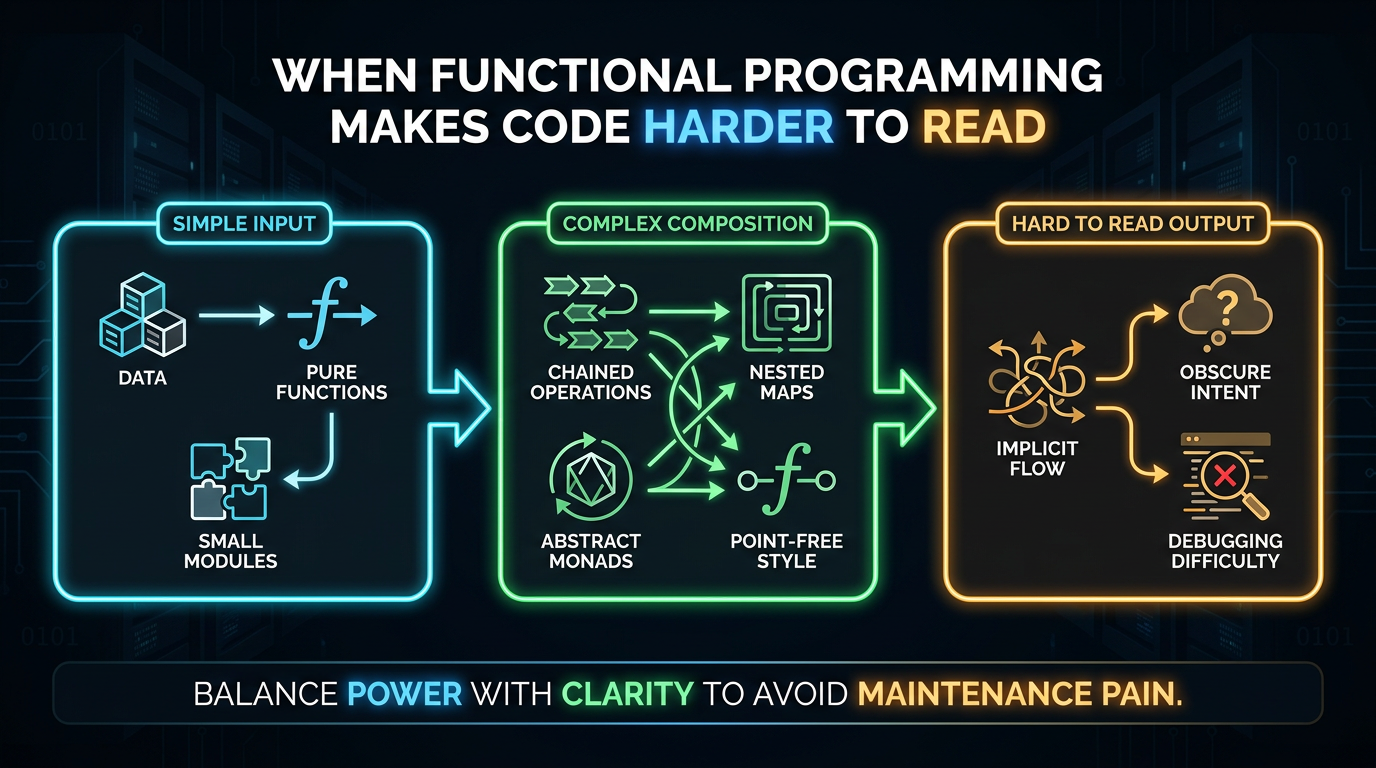
Functional programming should simplify code, not make it feel like a puzzle.
Readability often suffers when:
- Multiple map(), filter(), and reduce() calls are deeply nested.
- Lambda expressions become long enough to hide the actual logic.
- Functional constructs are used where a simple loop is more expressive.
- Functions are composed excessively, forcing readers to mentally trace several layers of execution.
For example:
result = reduce(...,
         filter(...,
             map(...)))
Although this is valid, a list comprehension or a straightforward loop may communicate the same idea more clearly.
The goal is not to write more functional code; the goal is to write code that is easier to reason about.
Best Practices
- Write pure functions whenever possible so the output depends only on the inputs.
- Minimize side effects such as modifying global variables or mutable objects.
- Prefer immutable data where practical because it reduces unexpected state changes.
- Use lambda only for short, self-contained expressions.
- Prefer list comprehensions over map() and filter() for simple transformations, as they are generally more idiomatic and readable in Python.
- Build programs by composing small, focused functions instead of writing large, monolithic functions.
- Choose the programming style that makes the code easiest to understand rather than forcing a functional approach.
Common Mistakes
Treating Every Function That Returns a Value as Pure
Returning a value does not automatically make a function pure. A function that modifies external state or depends on changing global data still has side effects.
Overusing Lambda Functions
Lambda functions are intended for concise expressions. If the logic requires multiple steps or explanation, a regular function defined with def is clearer.
Assuming Functional Programming Eliminates State
Functional programming aims to reduce mutable state, not eliminate it completely. Many real-world Python programs using functions combine functional and imperative techniques.
Using reduce() Where Simpler Alternatives Exist
For common operations such as summing values or finding a maximum, built-in functions like sum() and max() are usually more readable than reduce().
Writing Clever Instead of Readable Code
Functional programming encourages abstraction, but excessive composition or deeply nested function calls can make code harder, not easier, to maintain.
Summary
Functional programming in Python is less about replacing loops with map() or lambda and more about writing code that is predictable, composable, and easier to reason about. By treating functions as first-class objects, minimizing side effects, and composing small, focused functions, you can build programs that are easier to test, reuse, and maintain. At the same time, Python's multi-paradigm design means functional programming is one tool among many, using it where it improves clarity, rather than everywhere, leads to cleaner and more maintainable code.
Frequently Asked Questions
Is Python a functional programming language?▾
Python is a multi-paradigm language. It supports functional programming alongside procedural and object-oriented programming, allowing developers to choose the style that best fits the problem.
What is a pure function in Python?▾
A pure function in Python always returns the same output for the same input and does not produce side effects such as modifying external state or mutable objects.
Why are functions called first-class objects?▾
Functions are first-class objects because they can be assigned to variables, passed as arguments, returned from other functions, and stored in data structures like any other object.
Why are list comprehensions often preferred over map() and filter()?▾
For simple transformations and filtering, list comprehensions combine iteration and logic in a single, readable expression. They are generally considered more Pythonic than using map() or filter() with simple lambda functions.
How do closures relate to functional programming?▾
Closures allow a function to capture values from its enclosing scope. This enables functions to retain state, create specialized functions dynamically, and build higher-order abstractions without relying on global variables.