Key Takeaways
- Learn what recursion in Python, how they operate, and why they might call themselves to solve smaller versions of the same issue.
- Discover the base case and recursive case, the two fundamental components of recursion, and why each is necessary for proper execution.
- Trace recursive function calls step by step to see how Python creates stack frames, returns values, and eventually reaches the final result.
- Explore practical uses of recursion, including recursive algorithms, tree-like structures, nested data, and classic examples such as factorial and Fibonacci.
- Learn about such as RecursionError, recursion depth restrictions, and circumstances when an iterative approach is preferable.
Introduction
"Recursion is not about repeating the same work; it's about solving the same problem on a smaller scale."
Picture yourself observing your reflection as it continues to repeat in the distance. Recursion first feels a lot like this: a function that calls itself repeatedly appears to never end. However, one of the most sophisticated programming problem-solving strategies is hidden beneath this seemingly never-ending cycle.
From calculating factorials and generating the Fibonacci sequence to traversing trees and nested data, recursion in Python helps break complex problems into simpler, manageable steps. In this blog, you'll learn what is recursion in Python, how recursive functions execute behind the scenes, when recursion is the right choice, and where its limitations can make an iterative solution a better fit.
What Is Recursion in Python?
Recursion in Python is a programming method where a function calls itself with a lesser or simpler version of the same problem in order to solve the problem. Instead of handling the entire problem at once, each recursive call reduces the work until a stopping condition is reached.
A recursive solution typically consists of two parts: a base case, which stops the recursion, and a recursive case, which continues breaking the problem into smaller subproblems.
Recursion is especially useful for problems that have a naturally repetitive or hierarchical structure, such as tree traversal, nested data, and mathematical computations.
Recursive Function Definition
A recursive function is one either directly or indirectly while it is being executed. With each recursive call, a tiny version of the original problem is addressed, progressively leading to a solution.
Here's a simple recursive function example:
def countdown(n):
    if n == 0:
        print("Done!")
        return
    print(n)
    countdown(n - 1)
When countdown(3) is called, the function repeatedly calls itself with a smaller value until it reaches 0, where the recursion stops.
The key idea isn't that the function calls itself; it's that every recursive call makes progress toward a stopping condition.
Why Do We Use Recursion?
Some problems become easier to solve when they are expressed as smaller versions of themselves. Instead of writing complex loops or manually tracking intermediate states, recursion lets the function focus on solving one small step at a time.
The use of recursion is common in scenarios where the data or problem is recursive by nature, such as:
- Traversing tree structures
- Exploring nested folders or JSON objects
- Solving divide-and-conquer algorithms
- Computing mathematical sequences like factorial and Fibonacci
When a problem can be broken into similar subproblems, recursion often produces a cleaner and more intuitive solution than iteration.
Understanding How Recursive Functions Work
Every recursive function in Python follows the same execution pattern:
- Check whether the problem has reached a stopping condition.
- If not, reduce the problem into a smaller version.
- Call the same function with the reduced problem.
- Continue until the base case is reached.
- Return the results back through the previous function calls.
This process allows Python to solve complex problems by repeatedly applying the same logic to progressively smaller inputs.
Recursion Syntax
Although recursive functions solve different problems, they all follow a similar structure:
def function_name(parameters):
    if base_case:
        return value
    return function_name(smaller_problem)
This recursion syntax highlights the two essential components of every recursive function: a condition that stops the recursion and a recursive call that moves the solution closer to that condition.
What is Base Case in Recursion?
The base case is the stopping condition of a recursive function. It defines the simplest form of the problem that can be solved without making another recursive call.
Without a base case, the function would continue calling itself indefinitely, eventually raising a RecursionError.
For example, in the countdown() function, n == 0 is the base case because the function stops making recursive calls once it reaches zero.
Think of the base case as the exit door that prevents recursion from running forever.
The Recursive Case
The recursive case is the part of the function where it calls itself with a smaller or simpler version of the original problem.
Each recursive call must make measurable progress toward the base case. If the problem size doesn't decrease, the recursion will never terminate.
In the countdown() example, the statement:
countdown(n - 1)is the recursive case because it reduces the value of n by one with each call, ensuring the function eventually reaches the base case.
Together, the base case and the recursive case form the foundation of every recursive algorithm. Without either one, recursion cannot produce a correct solution.
What Happens During Recursive Execution?

The current function call a recursive function is called. Rather, Python initiates a new call, stops the existing one, and keeps doing this until the base case is encountered. The paused function calls resume one by one once the base case returns a value, ultimately yielding the final result.
Understanding this execution flow is key to understanding how recursion works.
The Call Stack and Recursion
Python's call stack is a data structure that records all function calls that are currently in use.
Python adds the stack when a recursive function calls itself. Until the base case is achieved, this process is repeated. Python restarts the previous call and removes each function from the stack as it completes.
You can think of the call stack as a stack of books; the last book placed on top is the first one removed. Recursive functions follow the same Last In, First Out (LIFO) order.
How Recursive Calls Create Stack Frames
Each recursive call creates a new stack frame, which stores that call's local variables, parameters, and execution state.
Even though the same function is called repeatedly, every call has its own independent stack frame.
For example, calling factorial(4) creates separate stack frames for:
factorial(4)
factorial(3)
factorial(2)
factorial(1)
Each frame remains on the call stack until it finishes execution.
Tracing Recursive Execution Step by Step
Tracing recursion helps you understand the order in which function calls are made and completed.
Consider this recursive function:
def countdown(n):
    if n == 0:
        print("Done!")
        return
    print(n)
    countdown(n - 1)
Calling countdown(3) executes like this:
countdown(3)
    ↓
countdown(2)
    ↓
countdown(1)
    ↓
countdown(0)
    ↓
Base case reached
The recursive calls continue until the base case is reached. Only then does Python start returning from each pending function call.
How Return Values Move Back Through Recursive Calls
Once the base case returns a value, that value travels back through each waiting recursive call in reverse order.
For example:
def factorial(n):
    if n == 1:
        return 1
    return n * factorial(n - 1)
When factorial(4) is executed, the return values move back like this:
factorial(1) → 1
      ↑
factorial(2) → 2 × 1 = 2
      ↑
factorial(3) → 3 × 2 = 6
      ↑
factorial(4) → 4 × 6 = 24
Instead of producing the answer immediately, each recursive call waits for the next call to finish before completing its own calculation.
Recursion in Python Examples
Let's apply these concepts to a few classic recursive problems.
A Simple Recursive Function Example
A countdown function is one of the easiest ways to understand recursion.
def countdown(n):
    if n == 0:
        print("Done!")
        return

    print(n)
    countdown(n - 1)
Output
3
2
1
Done!
Each recursive call reduces n by one until the base case (n == 0) stops the recursion.
Factorial Using Recursion in Python
The product of every positive integer up to a certain number is the factorial of that number.
Mathematically,
5! = 5 × 4 × 3 × 2 × 1
A recursive implementation closely follows this definition.
def factorial(n):
    if n == 1:
        return 1
    return n * factorial(n - 1)
Calling factorial(5) returns:
120This works because each recursive call reduces the problem until it reaches the base case (factorial(1)), after which the results are combined as the function calls return.
Fibonacci Series Using Recursion in Python
In the Fibonacci sequence, every number is the sum of the two preceding numbers.
A recursive solution expresses this relationship naturally.
def fibonacci(n):
    if n <= 1:
        return n
    return fibonacci(n - 1) + fibonacci(n - 2)
Calling fibonacci(6) returns:
8Although this implementation is easy to understand, it recalculates the same values multiple times. As n grows, the number of recursive calls increases rapidly, making this approach inefficient for large inputs. We'll revisit this limitation later in the article.
Recursive Algorithms and Their Applications
Recursion is more than a programming technique, it's a problem-solving strategy. Many problems can be solved by repeatedly applying the same logic to smaller instances of the original problem. This approach forms the basis of recursive algorithms, which are widely used to process hierarchical data and divide complex tasks into manageable steps.
What Is a Recursive Algorithm?
A recursive algorithm breaks down an issue into one or more smaller variants in order to solve it. Instead of solving everything in a single step, it repeatedly applies the same logic until it reaches a base case.
For a recursive algorithm to work correctly, it must:
- Define a clear base case.
- Reduce the problem size with every recursive call.
- Eventually reach the base case.
Classic examples of recursive algorithms include computing factorials, generating the Fibonacci sequence, and traversing tree structures.
Common Uses of Recursion
Recursion is most effective when a problem has a self-similar structure, meaning the same operation can be applied repeatedly to smaller parts of the problem.
Some common uses of recursion include:
- Traversing trees and hierarchical data structures.
- Exploring nested folders in a file system.
- Processing nested lists, dictionaries, or JSON objects.
- Implementing divide-and-conquer algorithms like Merge Sort and Quick Sort.
- Solving mathematical problems such as factorials and the Fibonacci sequence.
In these cases, recursion often provides a more natural and readable solution than manually managing loops and intermediate states.
Recursion on Nested Data and Tree-Shaped Structures
Nested data and tree-shaped structures are naturally suited for recursion because each branch or nested element can be processed using the same logic.
Consider a folder containing subfolders. Each subfolder may contain more folders, creating a repeating hierarchy. Rather than writing separate logic for every level, a recursive function processes one folder and then calls itself for each subfolder until no more folders remain.
The same approach is used for:
- Directory traversal
- JSON parsing
- XML documents
- Binary trees
- Organization charts
Because each level follows the same pattern, recursion keeps the solution simple and scalable.
Recursion vs Iteration
Both recursion and iteration solve repetitive problems, but they approach them differently. Recursion relies on function calls, whereas iteration uses loops such as for and while.
Choosing between them depends on the problem, readability, and performance requirements.
Key Differences
| Recursion | Iteration |
|---|---|
| Uses function calls to repeat a task | Uses loops to repeat a task |
| Requires a base case to stop execution | Stops when the loop condition becomes false |
| For every function call, a new stack frame is created. | Reuses the same execution frame |
| Often produces cleaner code for recursive problems | Generally more memory-efficient |
| May raise RecursionError for deep recursion | Doesn't have recursion depth limitations |
Recursion is often easier to understand for hierarchical problems, while iteration is usually preferred for straightforward repetitive tasks because it avoids the overhead of multiple function calls.
Rewriting Recursive Algorithms Iteratively
Many recursive algorithms can also be written using loops. An iterative solution eliminates recursive calls and avoids growing the call stack.
For example, the recursive factorial function:
def factorial(n):
    if n == 1:
        return 1
    return n * factorial(n - 1)
can be rewritten iteratively as:
def factorial(n):
    result = 1
    for i in range(2, n + 1):
        result *= i
    return result
Both implementations produce the same result, but the iterative version uses constant stack space and can handle larger inputs without hitting Python's recursion limit.
As a general rule, choose recursion when the problem is naturally recursive and the solution becomes clearer. Choose iteration when performance, memory efficiency, or deep recursion is a concern.
Understanding the Limits of Recursion in Python
Recursion can make certain algorithms easier to understand, but it isn't always the best solution. Every recursive call consumes memory by creating a new stack frame, and Python places a limit on how many nested calls a program can make. Understanding these limitations helps you decide when recursion is appropriate and when an iterative solution is more practical.
Depth of Recursion
The depth of recursion is the number of active recursive calls on the call stack at a given point during execution. Every time a recursive function calls itself, Python creates another stack frame, increasing the recursion depth.
For example, calling factorial(5) creates five nested function calls before reaching the base case.
While shallow recursion works well, very deep recursion consumes more stack space and increases the risk of exceeding Python's recursion limit.
What Is RecursionError?
A RecursionError occurs when a recursive function exceeds Python's maximum recursion depth.
This usually happens when:
- A base case is missing.
- The recursive case never reaches the base case.
- The recursion is too deep for Python's call stack.
For example:
def infinite():
    infinite()
infinite()
Output
RecursionError: maximum recursion depth exceededA well-designed recursive function should always move closer to its base case to prevent this error.
Why Python Doesn't Optimize Tail Recursion
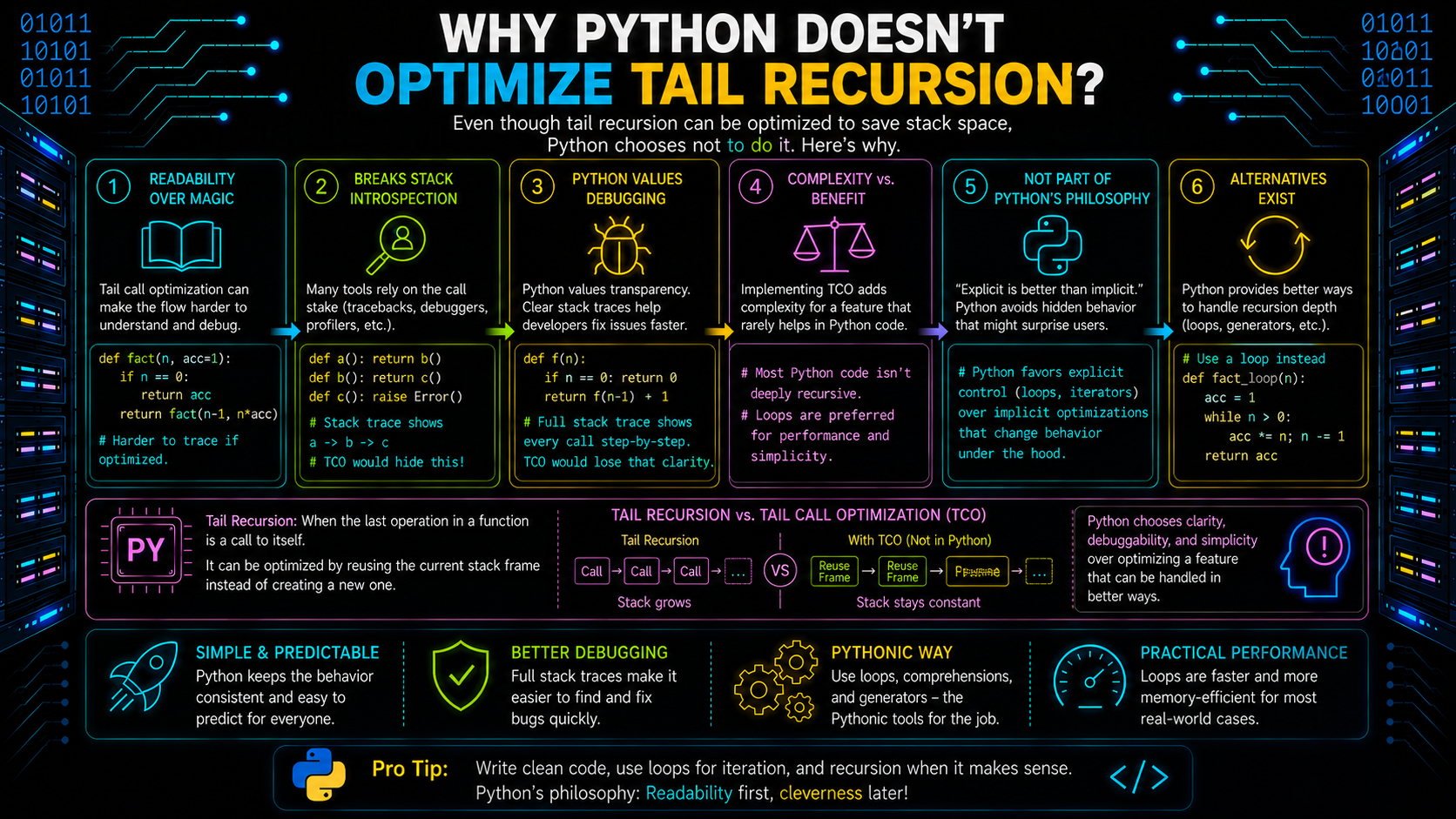
In some programming languages, tail recursion optimization (TRO) removes unnecessary stack frames, allowing deeply recursive functions to run efficiently.
Python does not perform tail recursion optimization. Even if the recursive call is the final operation in a function, Python creates a new stack frame for every call.
This design keeps stack traces complete, making programs easier to debug when an error occurs. However, it also means deeply recursive programs can quickly reach Python's recursion limit.
Where Recursion Breaks
Recursion is not suitable for every problem. It becomes less effective when the overhead of repeated function calls outweighs its readability.
Recursion is likely to break down when:
- The recursion depth becomes very large.
- The problem repeatedly computes the same values, as in the naïve recursive Fibonacci algorithm.
- An iterative solution is simpler and more memory-efficient.
- The recursive function doesn't make progress toward the base case.
In such cases, using loops, memoization, or iterative algorithms often results in better performance and avoids recursion-related limitations.
Best Practices for Writing Recursive Functions
Writing recursive functions becomes much easier when you follow a few fundamental principles.
- Always define a base case. Every recursive function needs a stopping condition to prevent infinite recursion.
- Reduce the problem with each recursive call. Every call should move closer to the base case. If the input doesn't change, the recursion won't terminate.
- Keep the recursive logic simple. A recursive function should focus on solving one smaller version of the problem instead of handling multiple responsibilities.
- Trace recursive execution while debugging. Following the sequence of function calls and return values helps identify logical errors.
- Choose recursion only when it fits the problem. For deeply nested or repetitive computations, an iterative approach may be more efficient.
Common Mistakes to Avoid
Even small mistakes can cause recursive functions to fail or behave unexpectedly.
- Missing the base case: Without a stopping condition, the function keeps calling itself until Python raises a RecursionError.
- Not making progress toward the base case: Calling the function with the same or a larger input results in infinite recursion.
- Ignoring how return values propagate: Recursive calls often depend on the value returned by the next call. Returning the wrong value can produce incorrect results.
- Using recursion for every repetitive task: Not every loop should be replaced with recursion. Simple iterative problems are often better solved with loops.
- Overlooking recursion depth: Deep recursion increases memory usage and may exceed Python's recursion limit.
Summary
Recursion is a powerful problem-solving technique that allows a function to solve a problem by repeatedly working on smaller versions of the same problem. In this guide, you learned what recursion in Python is, how recursive functions execute through the call stack, the importance of the base case and recursive case, and how return values flow back through recursive calls. Additionally, you studied Python-specific constraints like recursion depth and RecursionError, comprehended the function of recursive algorithms, contrasted recursion with iteration, and investigated well-known examples like factorial and Fibonacci. Recursion can make some algorithms more understandable, but it must be used carefully to keep your programs accurate and effective.
Frequently Asked Questions
1. What is recursion in Python?▾
Recursion in Python is a method where a function calls itself to solve an issue by decomposing it into smaller, related subproblems until it finds a base case.
2. What is recursive function?▾
A recursive function is a function that directly or indirectly calls itself during execution while reducing the problem size with each call.
3. Why is a base case important in recursion?▾
The base case stops the recursive calls. Without it, the function would continue calling itself indefinitely and eventually raise a RecursionError.
4. What is the difference between recursion and iteration?▾
Iteration employs loops like for and while, whereas recursion uses repeated function calls to solve issues. While iteration is often more memory-efficient, recursion frequently yields clearer solutions for hierarchical issues.
5. What is recursive algorithm?▾
Until it reaches a base case, a recursive algorithm solves a problem by repeatedly applying the same reasoning to smaller copies of the original problem.
6. What causes a RecursionError in Python?▾
When a recursive function goes above Python's maximum recursion depth, a RecursionError is raised. This generally happens because the base case is either missing, inaccessible, or the recursion is too deep.
7. When should recursion be used?▾
Recursion is best suited for problems involving hierarchical or self-similar structures, such as trees, nested data, directory traversal, and divide-and-conquer algorithms.
8. Does Python optimize tail recursion?▾
Because Python does not optimize tail recursion, each recursive call adds to the recursion depth and generates a new stack frame.