Key Highlights
- The Python stack represents active function calls and associated frames.
- The heap in Python is a useful conceptual model for Python-managed objects.
- Highly literal C-style stack and heap rules shouldn't be used to explain Python.
- Function calls create frames containing local names and references.
- Names refer to objects; they do not contain independent copies of those objects.
- Lists, dictionaries, and custom structures can all hold references to other objects.
- If an object is still reached by another reference after a function returns, it can survive.
- Recursion adds frames to the call stack and can eventually raise RecursionError.
- Stack vs heap memory is different from object lifetime and variable scope.
Introduction
A recursive function can continue adding execution frames until Python raises RecursionError, two Python variables can point to the same object, and a function can vanish while the object it produced endures.
So, in reality, where is everything kept?
Python requires more attention, but the standard stack vs. heap description is a good place to start. Python handles object management automatically, in contrast to languages where programmers must explicitly allocate and free memory. A function call generates a frame, which is filled with names and references to Python objects that are managed independently.
That gives us a better mental model:
function call
      ↓
    frame
      ↓
 local names
      ↓
 references
      ↓
 Python objects
Understanding this model makes the difference between stack and heap much easier to reason about, without pretending that Python follows the same memory rules as C.
What Does "Stack" Mean in Python?
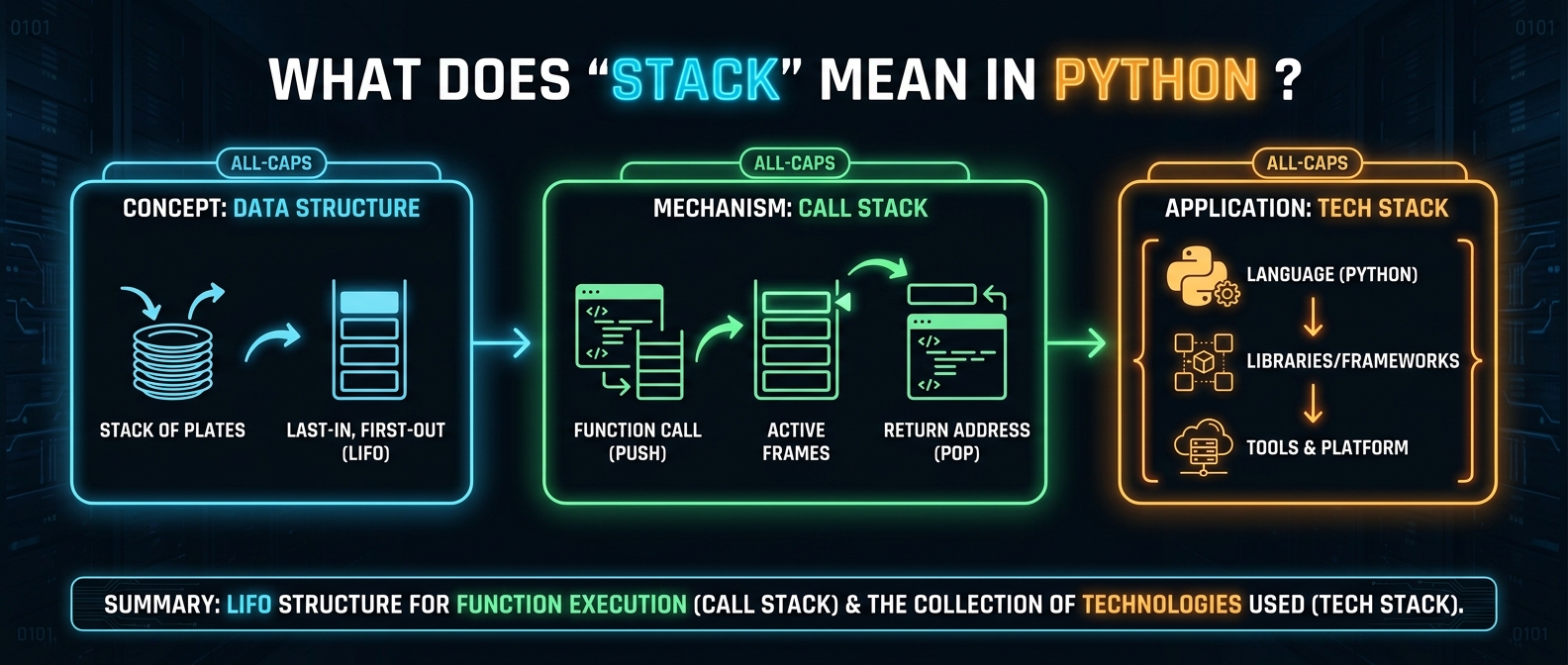
The stack represents the chain of currently active function calls.
When Python calls a function, it creates a frame for that call. The frame is pushed onto the call stack. When the function returns, that frame is removed.
Consider:
def first():
    second()
def second():
    third()
def third():
    print("Running")
first()
While third() is executing, the conceptual call stack is:
top
┌──────────────┐
│ third frame                  │
├──────────────┤
│ second frame              │
├──────────────┤
│ first frame                   │
├──────────────┤
│ module frame             │
└──────────────┘
bottom
The stack answers three important questions:
- Which function is running?
- Which function called it?
- Where should execution return?
This is the Python stack in the sense that matters for understanding function execution. It is primarily about active execution state, not a place where every Python value is simply stored.
What Is a Stack Frame?
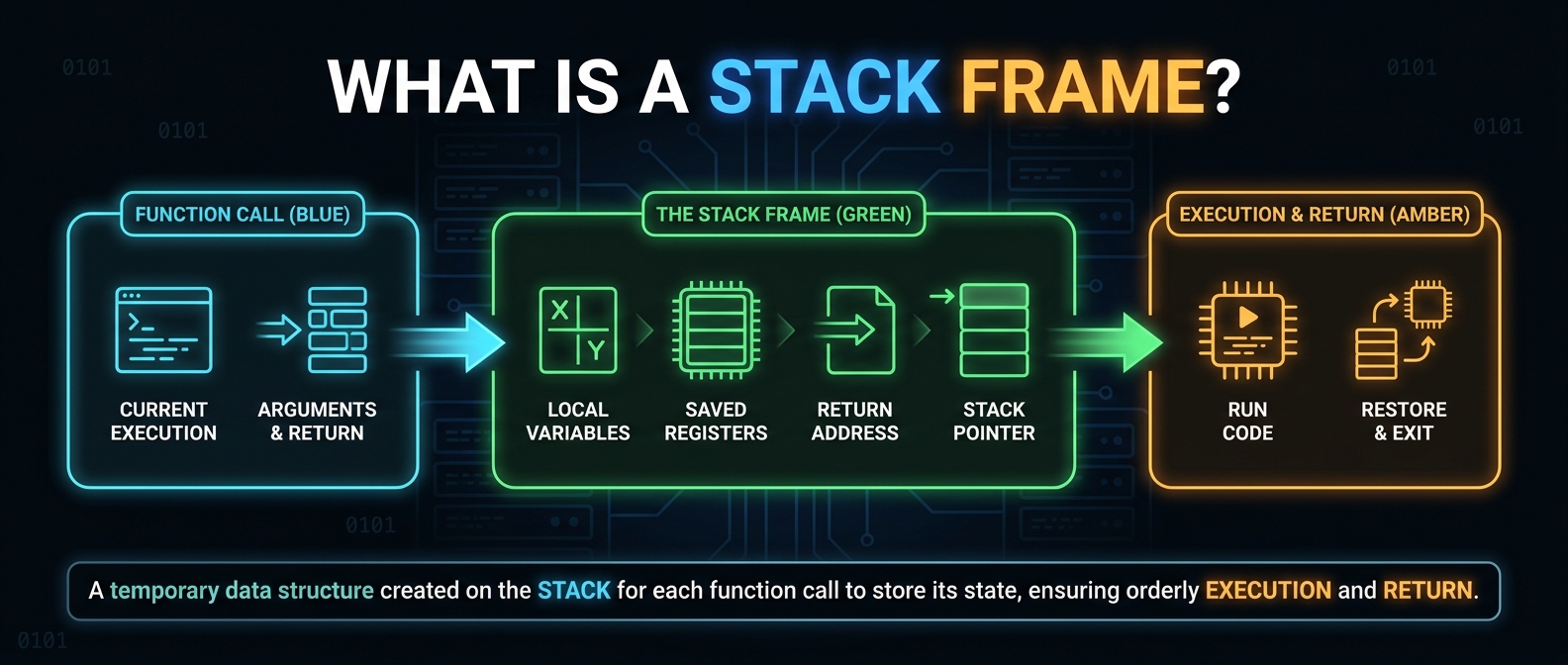
The runtime record linked to an active function call is called a stack frame.
For example:
def total(a, b):
    result = a + b
    return result
answer = total(2, 3)
While total() executes, the conceptual frame contains:
total frame
├── a  ──▶ 2
├── b  ──▶ 3
└── result ──▶ 5
The important detail is that the frame contains names and references to objects. It is not a collection of boxes containing complete independent Python objects.
What is a Heap in Memory?
The heap is commonly used to describe the area of memory where dynamically managed objects live.
A more reliable explanation for Python is:
Python objects live in Python-managed memory; "heap" is a useful conceptual term for that object memory.
For example:
name = "Ada"
numbers = [1, 2, 3]
settings = {"debug": True}
Conceptually:
module frame
├── name     ─────▶ "Ada"
├── numbers  ─────▶ [1, 2, 3]
└── settings ─────▶ {"debug": True}
The frame contains the names and references. The objects are managed separately.
So when someone asks "what is heap in memory?", the Python-specific answer should avoid implying that Python programmers manually allocate and free heap blocks. Python manages its objects for you.
Stack vs Heap in Python
The common stack vs heap memory model can be summarized like this:
Concept | Stack | Heap
Main role | Active function execution | Python-managed object memory
Associated with | Function calls and frames | Python objects
Contains conceptually | Local names, references, execution state | Lists, dictionaries, strings, custom objects, etc.
Lifetime | Active call | Depends on object references and lifecycle
Example | process() frame | List created by process()
This is a conceptual model, not a literal map of every memory detail inside every Python implementation. The Quainy Labs chapter explicitly emphasizes this caution.
Why Python Stack vs Heap Explanations Need Care
If you have studied C or another lower-level language, you may have learned:
Local variables → stackDynamically allocated objects → heap
That model does not transfer directly to Python.
Python does not require you to manually write:
malloc()
free()
Instead, Python manages objects and their lifetimes.
A better model is:
names → references → objectsWhile objects are managed independently, frames have local names and references.
Therefore, rather interpreting each variable as a physical stack allocation, heap vs. stack memory in Python should be addressed in terms of execution frames versus object management.
Names Are Not Boxes
This is one of the most important ideas in Python memory management.
Consider:
a = [1, 2]
b = a
A misleading mental model is:
a → copied list
b → copied list
Python actually behaves conceptually like this:
a ─────┐
               ▼
             [1, 2]
               ▲
b ─────┘
There is one list object and two references.
Therefore:
b.append(3)

print(a)
produces:
[1, 2, 3]b did not modify a copy. Both names referred to the same list.
This reference model is much more useful than imagining variables as physical boxes.
How Frames Connect to Objects
Consider:
def create_user():
    user = {"name": "Ada"}
    return user

account = create_user()
During the function call:
create_user frame
└── user ─────▶ dictionary object
After the function returns:
module frame
└── account ──▶ same dictionary object
When the function frame finishes, the local name user vanishes, but the dictionary endures because account now refers to it.
This demonstrates an important rule:
A frame can disappear while an object referenced by that frame continues to exist.
Object Lifetime vs Variable Scope
These concepts are related but different.
Scope asks:
Where can this name be used?
Object lifetime asks:
How long does this object exist?
For example:
def make():
    value = [1, 2, 3]
    return value
result = make()
After make() returns, the name value cannot be read directly because of its function-local scope.
However, the list is still in existence because the result makes reference to it.
So:
local name ended
        ↓
object survived
When understanding garbage collection and reference counting, this distinction becomes crucial.
Lists, Dictionaries, and Custom Structures Store References
References to other objects can be stored in Python containers.
Consider:
inner = [1, 2]
outer = [inner]
inner.append(3)
print(outer)
Output:
[[1, 2, 3]]Conceptually:
inner ─────▶ [1, 2, 3]
outer ─────▶ outer list
                │
                └── index 0 ──▶ same inner list
The outer list stores a reference to the inner list. It does not automatically create a deep copy.
The same idea applies to dictionaries:
user = {
    "name": "Ada",
    "roles": ["admin", "editor"]
}
Conceptually:
dictionary
├── "name"  ──▶ "Ada"
└── "roles" ──▶ list
                ├── "admin"
                └── "editor"
Custom data structures can create the same kind of object relationships because they can contain references to lists, dictionaries, sets, or other objects.
This connects directly to the earlier topic of Python Data Structures.
Why Objects Can Outlive Function Calls
Consider:
def make_numbers():
    numbers = [1, 2, 3]
    return numbers

result = make_numbers()
During execution:
make_numbers frame
└── numbers ──▶ list
After the function returns:
module frame
└── result ──▶ same list
The list persists since the result still reaches it even tho the function frame has vanished.
Now compare:
def make_numbers():
    numbers = [1, 2, 3]
make_numbers()
Here, the list becomes unreachable after the function returns.
That distinction prepares us for the next memory-management concepts: reference counting and garbage collection.
Recursion and Stack Growth
Visualizing stack growth is made simple by recursion.
def countdown(n):
    if n == 0:
        return
    countdown(n - 1)
countdown(3)
The conceptual call stack's deepest level includes:
countdown(0)
countdown(1)
countdown(2)
countdown(3)
module
Each recursive call creates another frame, and each frame has its own local n.
If recursion becomes too deep, Python can raise:
RecursionError
This is related to call-stack growth, not to the heap simply running out of space.
Stack vs Heap: A Large Object Example
Suppose a large list is passed to a function:
def process(items):
    return len(items)

big = list(range(1_000_000))
print(process(big))
Just because huge is supplied as a parameter does not cause the method to generate another million-element list.
Conceptually:
module frame
└── big ──────▶ large list

process frame
└── items ────▶ same large list
The parameter items refers to the existing object.
This is one reason Python's reference model matters when reasoning about memory usage and mutation.
When to Use Heap vs Stack?
The phrase "when to use heap vs stack" can be misleading in Python because programmers generally do not choose where ordinary Python objects are allocated.
You choose data structures and program designs, while Python manages the underlying memory.
For example:
- Do you require sequential data? Make use of a list.
- Need key-value lookup? Use a dictionary.
- Need a queue? Consider deque.
- Need a priority queue? Consider heapq.
- Need recursion? Understand its call-stack cost.
So don't think of Python programming as manually choosing "stack" or "heap" for each variable.
What Is a Heap vs Stack Memory in Operating Systems?
At the operating-system and low-level programming level, stack and heap refer to different memory-management concepts. A process typically has a stack associated with function execution and dynamically managed memory associated with the heap.
Python's high-level model should not be confused with that lower-level description.
The useful Python distinction is:
Stack → active function frames
Heap → conceptual Python-managed object memory
The Quainy Labs chapter specifically uses this distinction to build the correct Python mental model rather than teaching low-level C memory allocation.
Difference Between Stack and Heap
The practical difference is easier to remember this way:
Stack
- Keeps track of calls to active functions.
- Includes frames for execution.
- Grows as calls become nested.
- Shrinks as calls return.
- has a close connection to function execution and recursion.
Heap
- Represents Python-managed object memory conceptually.
- Contains objects such as lists and dictionaries.
- Objects can survive function calls.
- Object lifetime depends on references and reachability.
- Leads naturally into reference counting and garbage collection.
How to Create a Heap in Python
If by heap you mean the memory-management concept discussed above, you do not manually create one for ordinary Python objects.
However, Python also uses the word heap for a completely different data structure: a priority-queue structure provided by the heapq module.
For example:
import heapq
numbers = [5, 2, 8, 1]
heapq.heapify(numbers)
print(numbers[0])
Output:
1Here, heapq is implementing a heap data structure. That is completely different from asking where Python objects live in memory.
So:
Memory heap ≠ heap data structure.
How to Create Max Heap in Python
Instead of using a specific max-heap API, Python's heapq natively implements a min heap.
Negating the values is a popular method for numerical values:
import heapq

numbers = [5, 2, 8, 1]

max_heap = [-n for n in numbers]
heapq.heapify(max_heap)
largest = -heapq.heappop(max_heap)
print(largest)
Output:
8This is a heap data structure, not the memory heap discussed in this article.
Implementation of Heap in Python vs Memory Heap
The same word creates two different concepts:
Term | Meaning
Heap memory | Conceptual memory area for dynamically managed objects
Python heap data structure | A partially ordered structure used for priority queues
heapq | Python standard-library module implementing heap operations
Call stack | Structure representing active function calls
Keeping these meanings separate prevents one of the most common sources of confusion when learning Python memory management.
Summary
When function execution and object storage are kept apart, Python's stack vs heap become simpler to comprehend. Active frames are controlled by the call stack, whereas Python objects are managed independently. Objects can outlast the functions that produced them because names relate to objects rather than keeping copies. While object lifespan is dependent on reachability and references, recursion adds frames to the call stack. Additionally, heap memory and a heap data structure vary in that the former deals with memory management, while the latter facilitates functions like priority queues.
Frequently Asked Questions
1. In Python, what is the difference between stack and heap?▾
The stack represents active function calls and their frames, whereas the heap refers to Python-managed object memory. The implementation details of Python are more complex than a straightforward stack-versus-heap approach.
2. Are Python variables stored on the stack or heap?▾
It is more accurate to say that names refer to objects. A function frame contains local names and references, while the referenced Python objects are managed separately. Avoid treating a Python variable as a physical box stored entirely on either the stack or heap.
3. Is a stack frame created for each function call?▾
Certainly. Every Python function call that is currently in use has an execution frame that contains details about the execution state, parameters, and local names. Functions' frames are eliminated from the active call stack when they return.
4. Can an object survive after a function returns?▾
True. The item may continue to exist even after the function's frame vanishes if another reference continues to point to it. def create_list(): data = [1, 2, 3] return data result = create_list() Here, the local name data disappears, but the list remains reachable through result.
5. Is a Python heap the same as a heap data structure?▾
No. Heap memory refers to a memory-management concept, while a heap data structure is an algorithmic structure used for tasks such as priority queues. Python's heapq module implements the latter.