Key Highlights
- Learn the reasons for the creation of Python and the problems it was intended to address.
- Discover how Guido van Rossum's vision shaped Python into a language focused on readability and simplicity.
- Study how Python evolved from a side project to one of the most widely used programming languages worldwide.
- Understand how Python's evolution has improved performance, usability, and developer productivity.
- Deliver the background information required to understand Python's design philosophy, or the Zen of Python.
Introduction
Although programming languages are frequently evaluated based on their strength, Python gained popularity due to its ease of use. It seems more like problem-solving than learning a complicated language because of its clear syntax, accessible code, and user-friendly architecture. Guido van Rossum's idea that programming should be simple to read, write, and maintain was not coincidental.
What started off as a tiny open-source project has developed into one of the most popular programming languages in the world, supporting everything from web development to artificial intelligence. You will learn about Python's origins, development, and distinctive philosophy on this blog.
Why Was Python Created?
Because of their highly complex syntax and manual memory management, languages like C and C++ were strong by the late 1980s but frequently challenging to learn and maintain. Although scripting languages were more straightforward, they lacked the adaptability required for more complex applications.
By developing a language that was simple, legible, and potent, Guido van Rossum aimed to close this gap. His objective was to assist developers in writing clear, manageable code without sacrificing functionality.
Python was intended to be:
- Simple to read and understand
- Strong for practical uses
- Adaptable and expandable
- Productive for both small scripts and large projects
These ideas served as the cornerstone of Python's design philosophy and are still essential to the language today.
Guido van Rossum's Vision
In December 1989, while working at Centrum Wiskunde & Informatica (CWI) in the Netherlands, Guido van Rossum began developing a new programming language as a personal project during the Christmas holidays.
He wanted a language that removed unnecessary complexity while encouraging developers to write clean, understandable code.
Rather than creating a language filled with special symbols and complicated syntax, he chose simple, English-like keywords and indentation to organize code. This made programs easier to read, not only for the person who wrote them but also for anyone maintaining the code later.
One of Guido's core beliefs was that code is read more often than it is written. A program may be written once but read, modified, and debugged many times throughout its lifetime. Prioritizing readability would therefore make software development more efficient.
This idea continues to influence Python today and explains many of the language's unique design decisions.
The Birth of Python
Python officially appeared in 1991, when Guido van Rossum released its first public version.
Python became accessible as open-source software from the start, enabling programmers all over the world to use, research, enhance, and add to the language. Python developed quickly as more programmers joined its expanding community thanks to this cooperative approach.
Unlike many programming languages that were developed for a single company or product, Python was designed as a general-purpose language. Developers could use it for automation, scripting, scientific computing, web development, education, and many other applications.
Its clean syntax and versatility quickly attracted users who wanted to solve problems without spending unnecessary time dealing with complicated language rules.
Why Is It Called "Python"?
One of the most common misconceptions is that Python was named after the snake.
In reality, the name comes from the British comedy television series Monty Python's Flying Circus, which Guido van Rossum enjoyed watching.
He wanted a name that was short, unique, and memorable. "Python" met all those requirements and reflected the friendly, approachable nature he envisioned for the language.
Today, the snake has become Python's unofficial mascot, but the language itself has no connection to reptiles.
How Python Has Evolved
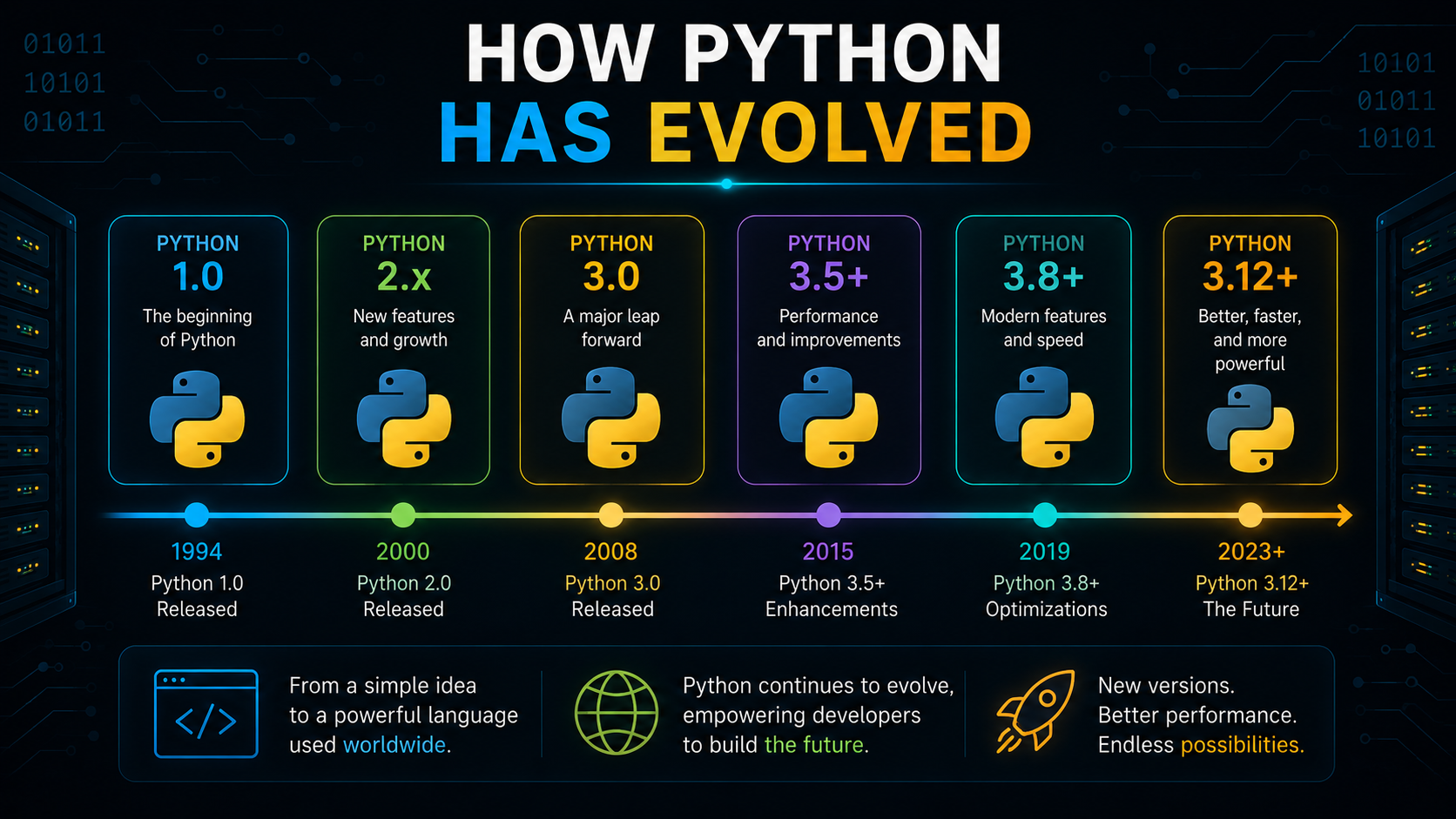
Python didn't become one of the world's most popular programming languages overnight. Over the years, it has continued to improve through community contributions, language enhancements, and a strong commitment to readability.
Rather than changing its philosophy, each major release refined the language while expanding its capabilities.
Python 1.x — Building the Foundation
The first public release introduced the core ideas that still define Python today.
It included:
- Clear and readable syntax
- Functions and modules
- Exception handling
- Support for object-oriented programming
Python showed that a programming language may be both straightforward and effective, despite being smaller than more recent iterations.
Python 2 — Growing Beyond Scripting
Python 2, which was released in 2000, brought about important advancements that contributed to the language's broad use in both academia and industry.
During this period:
- The standard library expanded considerably.
- More third-party libraries became available.
- Python gained popularity for web development, automation, and scientific computing.
- A large open-source community formed around the language.
Python is a popular option for teaching programming in schools and universities due to its simplicity of learning.
However, as Python continued to grow, developers recognized opportunities to improve the language by removing older design limitations.
Python 3 — A Better Future
In 2008, Python 3 was introduced with the goal of creating a cleaner, more consistent language.
Some changes were intentionally not backwards compatible, meaning certain Python 2 programs required updates before they could run on Python 3. Although this transition was challenging, it allowed the language to fix long-standing issues and improve consistency.
Python 3 introduced many enhancements, including:
- Improved Unicode support for handling text.
- Clearer syntax and language consistency.
- Better error messages.
- Performance improvements.
- Ongoing enhancements through regular releases.
Python 2 officially reached its end of life on January 1, 2020, and Python 3 became the standard version for development.
Today, Python continues to evolve through community-driven proposals known as Python Enhancement Proposals (PEPs). These proposals allow developers worldwide to suggest, discuss, and refine new language features while preserving Python's core philosophy of simplicity and readability.
The Zen of Python: The Philosophy Behind the Language
Every programming language has a set of design principles, whether explicitly stated or not. Python is unique because its philosophy is written down as The Zen of Python, a collection of guiding principles by Tim Peters, one of Python's early contributors.
These principles aren't strict rules. Instead, they encourage developers to write code that is simple, readable, and practical. They explain why Python looks the way it does and why certain language features exist while others don't.
One of the most interesting things about Python is that you can view these principles directly in the interpreter by typing:
import thisThe command displays 19 aphorisms, or short statements, that capture the philosophy behind Python's design. While every line offers valuable insight, a few principles have had the greatest influence on how Python is written today.
Beautiful Is Better Than Ugly
Good code isn't just about producing the correct output; it should also be easy to understand.
Python encourages clean formatting, meaningful variable names, and consistent coding practices so that programs remain readable even as they grow larger.
For example, a descriptive variable like student_name is much clearer than s or x. Small choices like these make code easier for everyone on a team to understand.
Simple Is Better Than Complex
Programming problems can often be solved in many different ways. Python encourages developers to choose the simplest solution that works.
Simple code is easier to debug, easier to test, and easier to maintain.
For example, instead of writing multiple lines to swap two variables, Python provides a simple approach:
a, b = b, aThe solution is concise without sacrificing readability.
Readability Counts
Perhaps the most famous principle in the Zen of Python is:
"Readability counts."
Programs are usually read many more times than they are written. A clear program saves time for everyone who works with it in the future.
This philosophy explains why Python uses indentation instead of braces ({}) to define code blocks. Consistent indentation makes the program structure immediately visible.
Compare these examples:
Less readable:
if marks>=40:print("Pass")More readable:
if marks >= 40:
    print("Pass")
Both produce the same output, but the second example is much easier to understand.
Explicit Is Better Than Implicit
Python encourages developers to write code that clearly expresses its purpose rather than relying on hidden behavior or assumptions.
Other developers can comprehend code that is explicit without having to assume how it operates.
This idea lessens confusion, particularly in big projects where a lot of people work on the same codebase.
Errors Should Never Pass Silently
Mistakes are inevitable in programming, but silently ignoring them often creates bigger problems later.
Python encourages developers to handle errors properly using exceptions.
For example:
try:
    file = open("data.txt")
except FileNotFoundError:
    print("File not found.")
Instead of allowing the program to fail unexpectedly, Python provides a clear way to identify and handle errors.
How the Zen of Python Shapes Everyday Coding

The Zen of Python isn't just a list of inspirational statements; it influences how developers write code every day.
For example, Python encourages:
- Meaningful variable and function names.
- Consistent indentation.
- Modular programs using functions and modules.
- Straightforward solutions instead of clever but confusing code.
- Proper exception handling instead of ignoring errors.
These practices make Python programs easier to read, debug, test, and maintain. This is one of the reasons Python is widely used in collaborative software projects, where code may be maintained by many developers over several years.
As Guido van Rossum often emphasized, code is read far more often than it is written. Writing readable code is, therefore, an investment in the future of the project.
Why Python Became So Popular
There isn't just one feature that makes Python so popular. It is the result of careful design, a vibrant community, and the capacity to address issues in a variety of fields.
The following are some of the main causes of Python's extensive use:
- Easy to learn: Its simple syntax makes it an excellent first programming language.
- Highly readable: Clean code reduces development and maintenance time.
- Versatile: Python is used for web development, automation, artificial intelligence, data science, cybersecurity, game development, and scientific computing.
- Rich ecosystem: Thousands of open-source libraries allow developers to build applications without starting from scratch.
- Cross-platform support: Python programs can run on Windows, Linux, and macOS with minimal changes.
- Strong community: A large global community continuously improves the language, develops libraries, and helps new learners.
These strengths have made Python one of the most widely used programming languages in education, research, startups, and enterprise software development.
Conclusion
Python's appeal stems from a philosophy of readability, simplicity, and practicality more than just its straightforward syntax. The Zen of Python pushes programmers to write clear, manageable code. You will be able to develop better programs and understand why Python is still one of the most popular programming languages in the world if you comprehend the concepts underlying its architecture.
Frequently Asked Questions
1. Who created Python?
Guido van Rossum started working on Python in 1989, and the first version was made available to the general public in 1991.
2. Why is Python called Python?
Python is not named after the snake, but rather from the British comedy series Monty Python's Flying Circus.
3. What is the Zen of Python?
The Zen of Python is a collection of 19 guiding principles written by Tim Peters that describe Python's philosophy of simplicity, readability, and practicality.
4. How can I view the Zen of Python?
Open the Python interpreter and run:
import thisThis command displays the Zen of Python.
5. Why is Python considered easy to learn?
Python is accessible to novices while maintaining its strength for professional growth thanks to its straightforward, legible syntax, consistent design principles, and extensive standard library.
6. Why is Python still popular today?
Python is still widely used in domains including artificial intelligence, data science, automation, web development, and scientific computing because it is simple to learn, extremely versatile, and maintained by a sizable community.